The types of automation systems used in food packaging range from standalone semi-automatic filling stations to fully integrated platforms that manage everything from product intake to final palletization without manual intervention. For facility managers and procurement teams, selecting the appropriate tier of mechanical integration dictates both capital expenditure and long-term operational consistency. Understanding these categories helps buyers match machinery investments with their exact production volume and scaling plans.
Relying entirely on manual packing lines exposes food manufacturers to severe labor turnover, inconsistent fill weights, and heightened contamination risks. When line speeds fluctuate because operators fatigue, overall equipment effectiveness drops, and per-unit costs rise. Upgrading to the correct automation tier stabilizes production, protects margins, and scales output to meet demanding retail and distributor distribution schedules.

What Are Semi-Automated Packaging Systems?
Semi-automated packaging systems require an operator to perform specific actions such as loading raw product into a filling station or initiating a seal cycle while the machine executes the primary mechanical function automatically.
Operational Flexibility and Lower Capital Risk
These setups require a lower initial investment while allowing the operator to retain pacing control. The operator might place a pre-made pouch under a dosing nozzle and press a foot pedal, leaving the machine to ensure accurate weight and tight sealing. They are particularly well-suited for high-mix, low-volume facilities where rapid changeovers are needed between different product batches. Because the machines are not rigidly linked by automated conveyors, technicians can clean or adjust one unit without halting the entire production floor.
Labor Dependency and Throughput Limits
Despite the mechanical assistance, throughput remains entirely dependent on human speed and stamina. A semi-automated line cannot run unattended, meaning labor costs remain a significant factor in the unit economics. Facilities often use this equipment for specialty runs, seasonal promotional packaging, or as an introductory step before committing to broader mechanical integration. The pacing is inherently limited to what a single operator can sustainably manage over an eight-hour shift.
Key Takeaway: Semi-automated equipment provides immediate consistency improvements for specialty or high-mix production lines without requiring the massive capital commitment of full integration.
How Do Fully Automated and Integrated Lines Function?
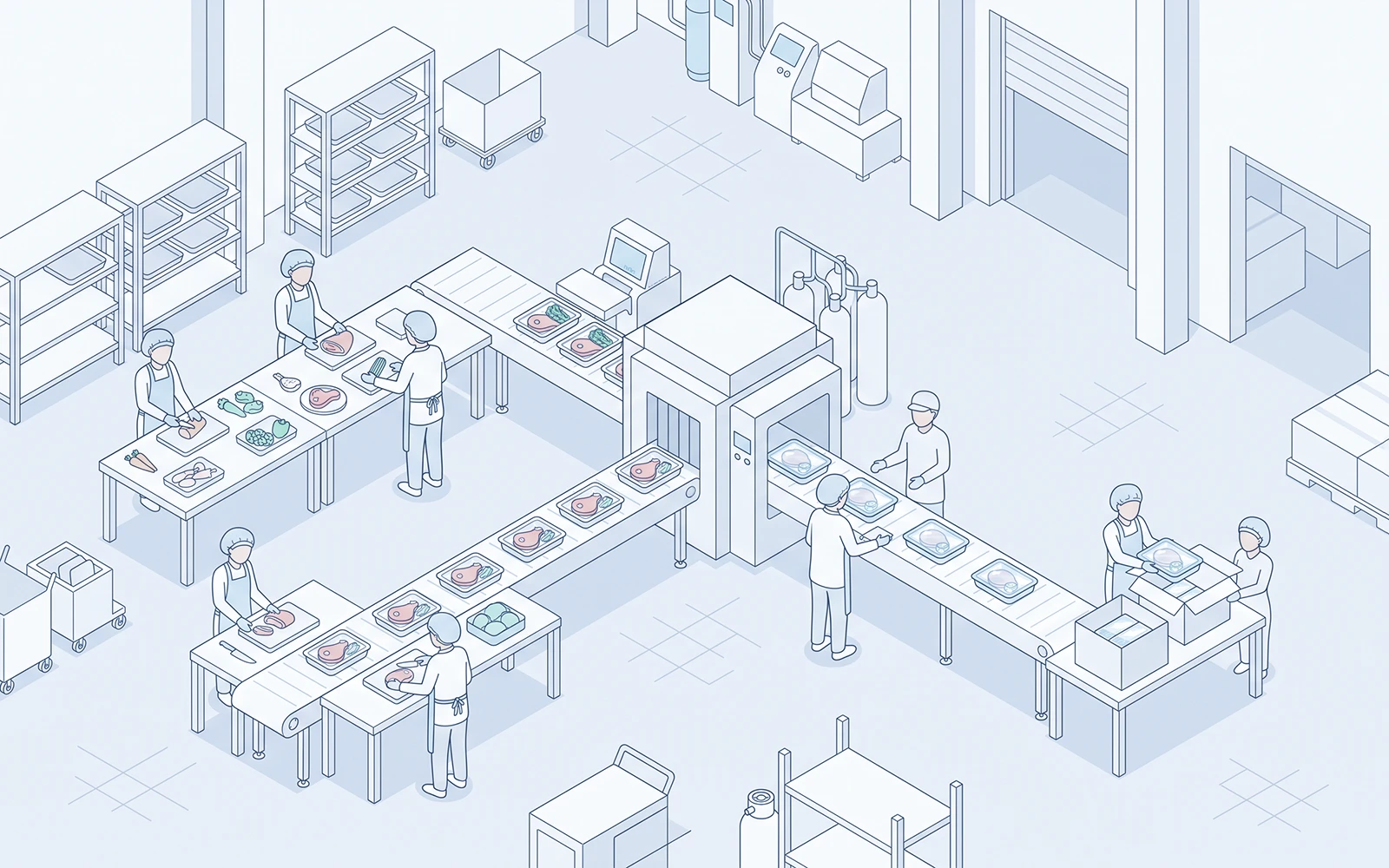
Fully automated and integrated lines handle every production step from bulk product intake to finished pallet wrapping without any manual intervention during the active run cycle.
Continuous Material Flow and Sensor Integration
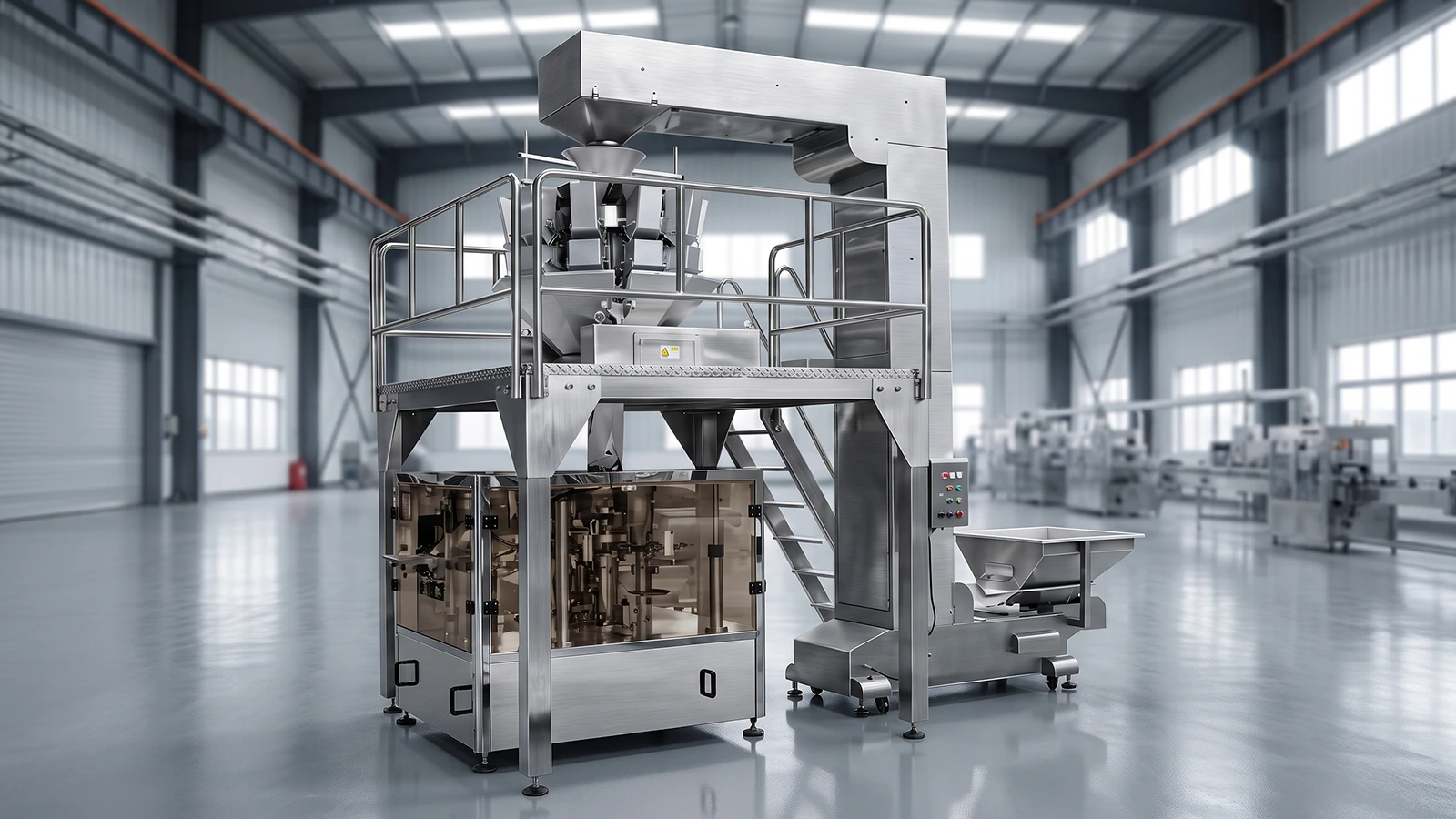
In a fully automated environment, optical sensors and load cells dictate the flow of materials. Multi-head weighers dynamically select the correct combination of buckets to achieve precise weights, vertical form-fill-seal machines drop the product into custom-formed bags, and checkweighers automatically reject off-target packages downstream. Robotic arms handle end-of-line case packing and palletizing. This continuous flow drastically drops the per-unit cost when operating at steady state, making it the standard for high-volume facilities with stable product portfolios.
Sourcing and Compatibility Complexities
Integration complexity increases exponentially as more machine types are linked together. Upstream processing must perfectly match the infeed rate of the packaging equipment, and downstream machines must absorb minor speed variations without causing backups. To avoid communication bottlenecks between different brands of equipment, buyers often seek compatible machinery from a single supplier or utilize an experienced system integrator to ensure seamless handoffs and unified control architecture.
Key Takeaway: Fully automated platforms dramatically lower per-unit production costs at scale, but they require rigorous upfront planning regarding equipment compatibility and line balancing.
What Is the Role of Control System Architecture?
Control system architecture serves as the central nervous system for any automated packaging line, dictating how individual machines coordinate timing, communicate faults, and report production data.
PLCs for Machine-Level Sequencing
Programmable logic controllers manage the specific mechanical cycles of each machine. They process inputs from local sensors and trigger outputs to servo motors or pneumatic cylinders with millisecond precision. On an integrated line, these controllers communicate with upstream and downstream equipment via industrial protocols to execute coordinated start-stop sequences, effectively preventing product pileups when a downstream machine pauses momentarily.
SCADA and HMI for Line Supervision
Supervisory control and data acquisition layers collect throughput rates, downtime events, and reject counts into a unified dashboard utilized for management reporting. Touchscreen human-machine interfaces allow operators to adjust timing parameters, load saved recipes, and view real-time status. A well-designed interface reduces training time and minimizes changeover errors by providing clear diagnostics and visual indicators precisely when a mechanical fault occurs.
Key Takeaway: A sophisticated control architecture reduces troubleshooting time and changeover errors by providing maintenance teams with clear, actionable data directly at the machine interface.
How Should Facilities Choose Between Automation Levels?
Choosing between semi-automated and fully automated systems depends on a careful evaluation of your production volume, product variability, budget constraints, and available facility layout.
Evaluating Product Mix and Changeover Frequency
A dedicated line running two product variants at high volume is an ideal candidate for full automation because the capital cost spreads across millions of units annually. Conversely, a facility running dozens of different items in small batches faces a different economic reality. Frequent changeovers make full automation expensive unless the equipment features rapid, toolless format changes. Understanding the true production volume per SKU prevents over-investing in rigid automated systems that sit idle during manual changeovers.
Implementing a Hybrid Automation Strategy
Many successful operations adopt a hybrid approach, targeting investment at their most painful bottleneck. A facility might install fully automated packaging systems for their primary bagging and weighing process while retaining manual case packing downstream. This strategy builds internal technical capability gradually while delivering immediate returns where they are needed most, preserving capital for future modular upgrades.
| Feature | Semi-Automated Systems | Fully Automated Lines |
| Capital Investment | Low to moderate | High |
| Operator Dependency | High | Low |
| Changeover Speed | Generally faster | Slower unless highly modular |
| Best Suited For | High mix, lower volume | Low mix, high volume |
| Floor Space | Compact, flexible | Extensive, fixed layout |
Key Takeaway: Evaluating production volume against SKU mix reveals whether full integration is justified or if a hybrid approach offers a more realistic return on investment.
What Are the Maintenance and Operational Impacts?
Upgrading your mechanical infrastructure fundamentally shifts your workforce requirements from manual handling tasks to technical supervision and preventative maintenance routines.
Shifting Skill Requirements
Automated lines require operators who understand interface screens and basic diagnostic troubleshooting rather than manual filling techniques. Maintenance staff need competence in logic controllers and servo drive tuning, which goes beyond traditional mechanical wrench-turning. Facilities that underestimate this operational shift often experience extended downtime during the first six months of operation as their workforce adapts to the new technical demands.
Managing Preventative Maintenance
Consistent uptime relies heavily on condition-based maintenance. Technicians must monitor wear parts, such as seal jaws, cutting blades, and pneumatic seals, replacing them before they degrade package quality. Partnering with a reliable machinery supplier ensures that spare parts remain available and remote diagnostic support can resolve software issues without waiting for an on-site technician to arrive.
Key Takeaway: Capital investments in packaging machinery must be paired with structured operator training budgets to prevent extended downtime during the critical commissioning phase.
Reliancepak, operating through our Autopackline brand, supplies food processing facilities, agricultural producers, and industrial manufacturers with reliable packaging machinery. Whether you are transitioning to semi-automatic equipment for the first time or designing a fully automatic production line, our B2B customization services ensure your machinery matches your exact operational constraints. With fast delivery from our China-based manufacturing center and comprehensive after-sales support, we help you reduce labor dependency and stabilize your output. Contact our technical team to discuss your facility requirements and explore efficient equipment solutions.
The future of the food packaging sector relies on adaptable equipment that scales intuitively alongside business growth. Facilities that implement flexible, data-driven machinery today will secure a distinct operational advantage as market demands continue to evolve.
FAQ Section
Can semi-automated machines be upgraded later?
Yes.
Many standalone machines are inherently modular. You can initially operate them manually and later integrate them with automated infeed conveyors, multi-head weighers, or downstream case packers as your production volumes naturally scale.
How do I reduce downtime during automated line changeovers?
Implement standardized changeover procedures.
- Utilize recipe-based parameter saving on the interface.
- Invest in toolless quick-release forming parts.
- Stage all necessary materials before stopping the machine.
What should I consider when buying an automatic line?
Evaluate your current operational bottlenecks.
- Assess the true production volume per product variant.
- Confirm compatibility between different machine brands.
- Ensure your facility has adequate electrical and compressed air infrastructure.