Mixed nuts and dried fruits sit in an awkward middle ground for packaging equipment: they are free-flowing enough to weigh automatically, but fragile enough to break, oily enough to stain films, and moisture-sensitive enough to lose texture without a proper seal. The “best” machine, then, is less about brand names and more about matching equipment type to your bag format, volume, and product mix.
This guide walks through the three machine categories most buyers compare for this application, what each does well, and the specification details that actually separate a good line from a frustrating one.
Why This Product Category Is Hard to Package
Before comparing machines, it helps to understand what makes nuts and dried fruit different from, say, puffed snacks or sugar.
- Mixed density and piece size. A blend of cashews, raisins, and dried apricot pieces does not flow uniformly, which affects both dosing speed and accuracy.
- Fragility. Walnut halves and dried banana chips score poorly on appearance if they are dropped or conveyed aggressively during filling.
- Surface oil and moisture migration. Nut oils can weaken some sealant layers over time, while dried fruit releases moisture that shortens shelf life without modified atmosphere packaging.
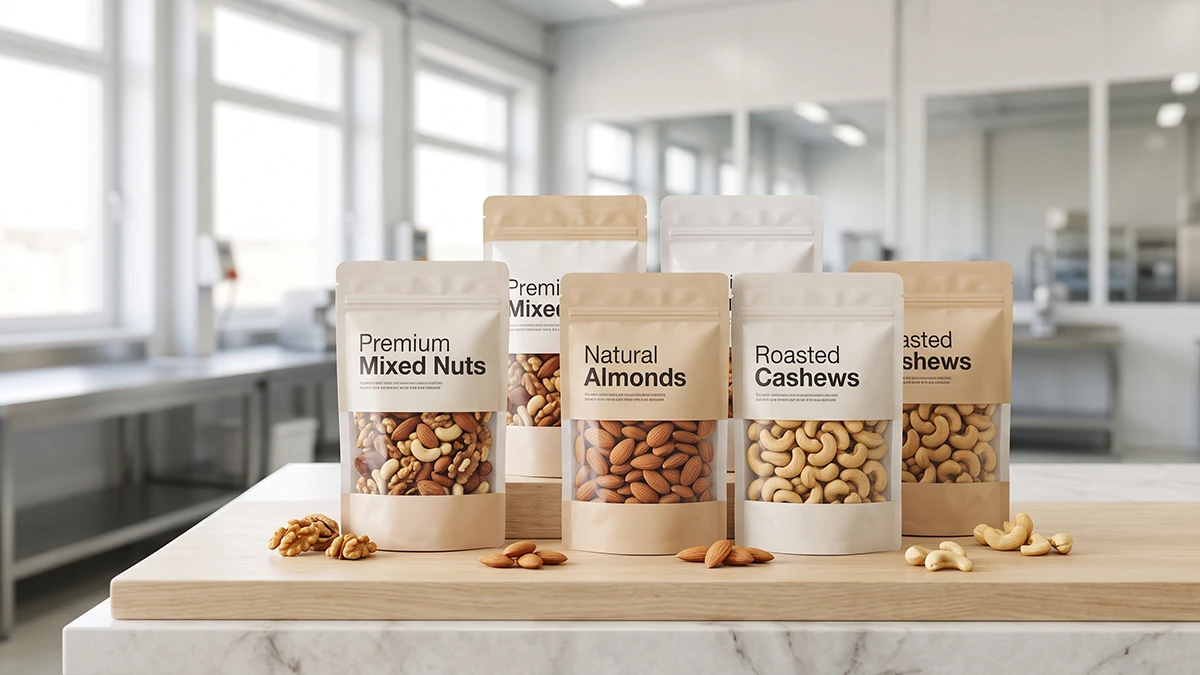
- Premium bag formats. This category sells at retail on visual appeal, so stand-up pouches with zippers and windows are common — and not every machine can handle them.
Any machine you shortlist should be judged against these four points, not just headline speed.
The Three Main Machine Categories
Option 1: Premade Pouch Rotary Machine with Multi-Head Weigher
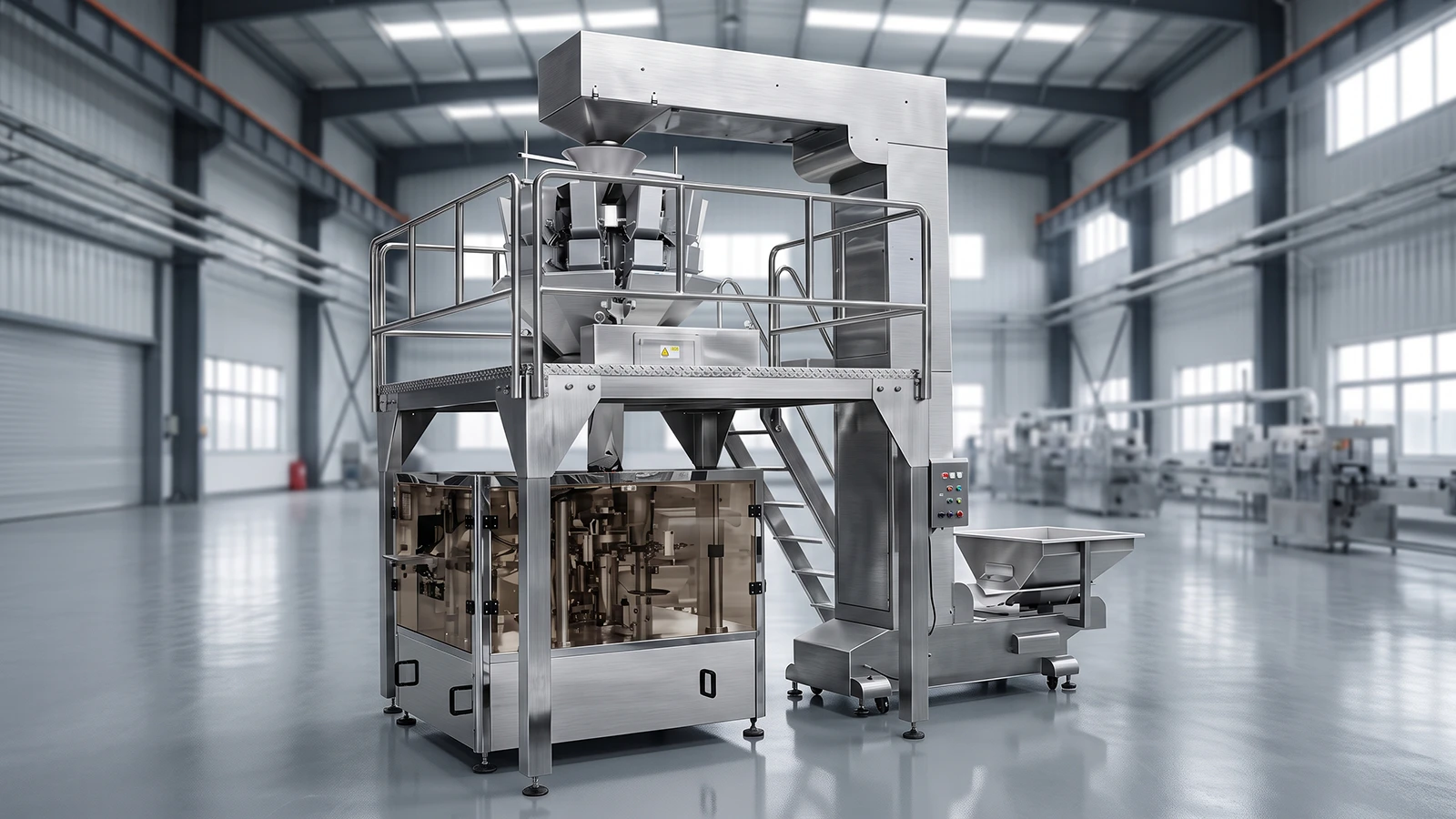
A rotary bag-feeding system picks up pre-made pouches (stand-up, zipper, 3-side seal), opens them, fills from a multi-head combination weigher, and heat-seals them on a rotating station turret. This is the route most nut and dried fruit brands with retail shelf presence eventually take, because the bag presentation is what consumers associate with premium products.
The strengths are straightforward: the bag is already formed, so seals and print placement are consistent; zipper pouches and shaped bags are supported; and a well-matched multi-head weigher typically keeps dosing accuracy within ±1%, which matters when your raw material is expensive.
The trade-offs are higher bag inventory cost (premade pouches cost more per unit than roll film), a larger footprint, and a longer setup than simpler systems.
Option 2: Vertical Form-Fill-Seal (VFFS) with Multi-Head Weigher
A VFFS machine forms its own bag from a roll of laminated film, fills it, and seals it in a vertical motion at high speed. For pure throughput on pillow bags or quad-seal bags, VFFS is usually the fastest and most film-economical option.
Where it falls short for this category: standard VFFS handles pillow and back-seal formats well, but zipper stand-up pouches require either a different machine class or significant modification. If your packaging strategy depends on resealable premium pouches, VFFS may box you in later.
Option 3: Semi-Automatic Filling (Manual Bag Loading)
For startups, co-packers running short runs, or brands testing a new SKU, a semi-automatic setup — weigher or scale plus manual bag placement and a bench sealer — can process a few bags per minute at a fraction of the capital cost.
The limitation is labor. As volume grows, per-bag labor cost quickly exceeds what you save on equipment, and manual filling introduces weighing inconsistency that shows up as giveaway cost on every shift.
Side-by-Side Comparison
| Factor | Premade Pouch Rotary | VFFS | Semi-Automatic |
|---|---|---|---|
| Typical speed | 20–60 bags/min | 40–120+ bags/min | 3–10 bags/min |
| Bag formats | Stand-up, zipper, 3/4-side seal | Pillow, quad-seal, back-seal | Depends on operator and sealer |
| Resealable zipper support | Yes | Limited / modified only | Manual or skip |
| Film vs. premade bag cost | Higher per-bag cost | Lowest film cost | Highest (small bags or pre-made) |
| Labor requirement | Low | Low | High |
| Footprint & power | Larger; ~4.5 kW class systems | Medium | Minimal |
| Capital investment | Highest | Medium–high | Low |
There is no single winner in this table. A brand shipping 20,000 premium zipper pouches a month has a different optimal answer than a co-packer running five SKUs at 2,000 bags a week.
What to Check Beyond the Brochure
Whichever category you lean toward, these are the details buyers most often regret skipping:
- Gentle vertical handling. Ask how product travels from hopper to weigher. An enclosed Z-type bucket elevator with food-grade buckets reduces breakage and segregation compared to open conveyors.
- Weighing accuracy at your target weight. ±1% on a 500 g bag of premium cashews is real money over a production year. Confirm accuracy at your dosing weight, not a demo weight.
- Bag style flexibility. If zipper stand-up pouches are on your roadmap, confirm the machine supports zipper opening modules now or as an upgrade — retrofitting later is rarely cheap.
- Nitrogen flush / MAP compatibility. Dried fruit shelf life improves noticeably with oxygen reduction. Check whether a gas flush system is available as an option.
- Sanitary construction. Product-contact zones in SUS304 or SUS316 stainless steel should be standard, not an upcharge, for food applications.
- Downstream integration. Checkweighers, metal detectors, and coding systems (TTO or CIJ) are usually added within the first year. Plan the layout now.
A Concrete Example: Automatic Premade Pouch System
To make the comparison concrete, here is how a typical automatic premade pouch packaging system in this class is specified. The configuration below — rotary bag-feeding machine, multi-head combination weigher, Z-type bucket elevator, and access platform — is the architecture we supply for nuts and dried fruit lines at Autopackline.
| Specification | Value |
|---|---|
| Packing speed | 20–60 bags/min (depending on material and dosing weight) |
| Measuring accuracy | ≤ ±1% (multi-head load cell system) |
| Bag size range | Length 80–350 mm, width 70–250 mm (quick-adjust grippers) |
| Bag styles | Stand-up (Doypack), 3/4-side seal, zipper pouches, pillow bags |
| Film / pouch materials | OPP, CPP, PE, PET, aluminum foil, composite laminates |
| Power consumption | Approx. 4.5 kW, 220V/380V 3-phase |
| Air supply | 0.8 MPa, ~0.3 m³/min (external compressor ≥1.0 m³/min) |
| Construction | SUS304 / SUS316 in product-contact zones |
| Total system height | ~3.6 m (weigher discharge to floor) |
Operationally, the line runs a “no bag – no fill – no seal” interlock: if a pouch is missing or misfed, the weigher holds discharge and the sealing jaws stay clean. A PLC touchscreen handles recipe storage and diagnostics, and optional upgrades include nitrogen flushing, zipper-opening modules, date coding, and inline checkweighing or metal detection.
Is this the right answer for every buyer? No. If your volumes are low or your bags are pillow-style only, a VFFS or semi-automatic setup will serve you better and cost less. But if premade premium pouches are the format you intend to compete with, this class of system is the one to benchmark against.
How to Decide
A practical sequence for narrowing the choice:
- Fix your bag format first. The bag decision drives the machine decision far more than speed specs do.
- Size the volume honestly. Use realistic shift output, not optimistic brochure numbers, to determine which category pays back.
- Request a product test run. Send your actual nut and fruit blend to the supplier. Filling behavior with your product is the only test that counts.
If you have your bag samples, target weight, and expected volumes in hand, our engineers can review your requirements and recommend a configuration — reach out through our contact page to start that conversation.
Frequently Asked Questions
Can one machine handle both nuts and dried fruit in the same blend?
Yes, in most cases. A multi-head combination weigher dosing a mixed blend works well, though large or sticky pieces (whole dried figs, candied fruit) may need wider weigh buckets or vibratory feeder adjustments. Always validate with a test run of your exact blend.
Is a multi-head weigher accurate enough for premium nuts?
Yes. Multi-head combination weighers typically achieve ±1% or better, which is well within retail declared-weight tolerances. Accuracy at your specific dosing weight should be confirmed during testing, since blend composition affects it.
Do I need nitrogen flushing for dried fruit?
Not strictly, but it is usually worth it. Dried fruit shelf life is limited by oxygen and moisture; nitrogen flushing in a sealed pouch can extend it noticeably at a modest operating cost. Check that gas flush is available as an option on any machine you buy.
How much floor space and power does an automatic premade pouch line need?
A typical rotary system with multi-head weigher stands about 3.6 m tall, draws roughly 4.5 kW on 3-phase power, and needs a clean compressed air supply around 0.3 m³/min at 0.8 MPa. Allow working space around the platform for operation and sanitation.
Premade pouches or roll film — which is cheaper long term?
It depends on volume and format. Roll film (VFFS) has the lowest per-bag material cost, but premade pouches avoid capital-intensive bag-forming hardware and support zippers and premium shapes. Above a certain volume with simple bag styles, VFFS wins on materials; for resealable stand-up formats, premade pouch systems are usually the more practical route.