Buying a pouch packaging line usually starts with two things: a product sample and a target output per shift. The harder part is confirming that the machine can hold that output across different bag sizes, film structures, and long production runs.
This guide explains how a fully automatic premade pouch system is configured and addresses the questions that come up most often during specification and quotation.
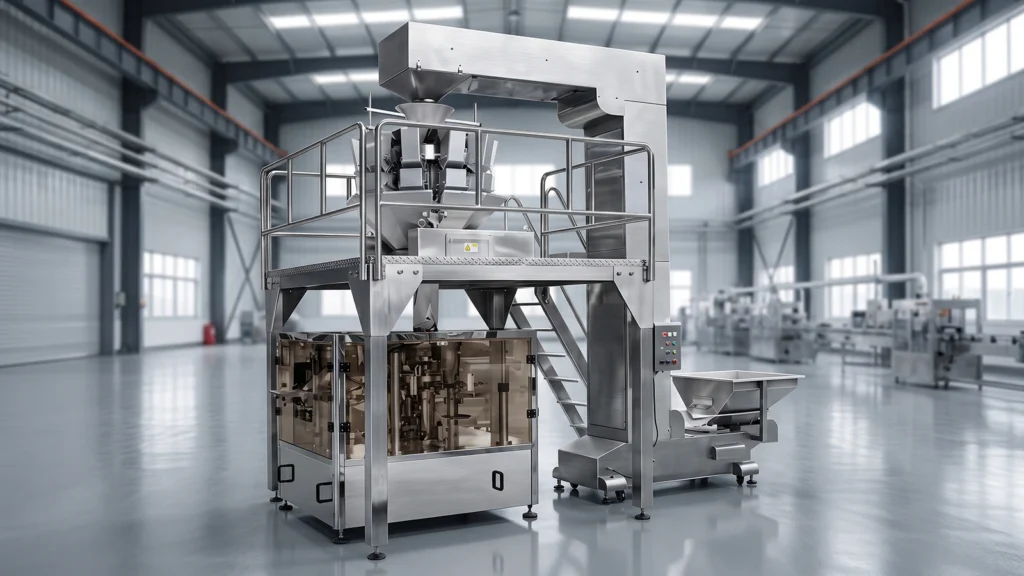
How the Line Is Configured
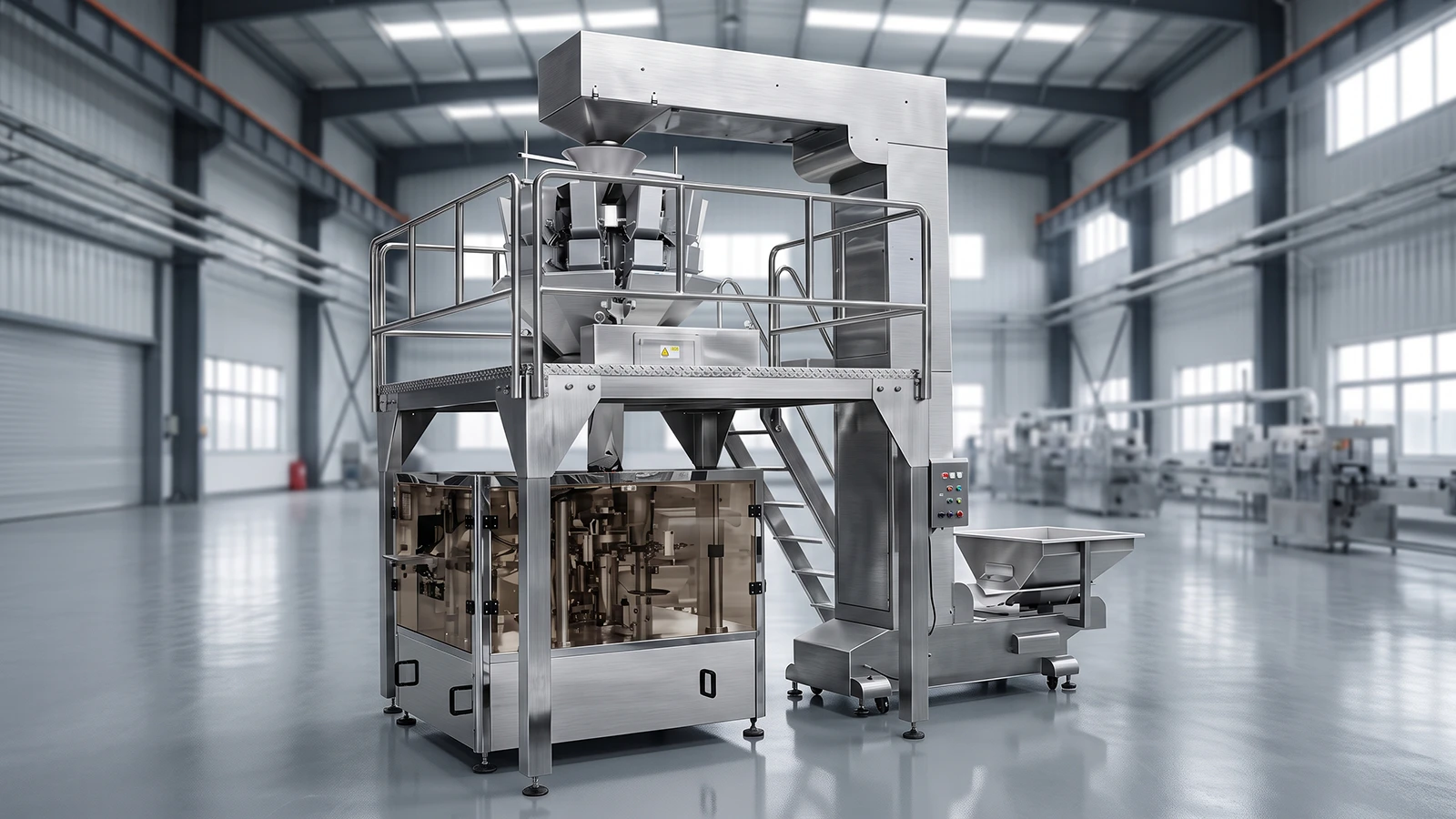
Rather than a single machine, this is a four-unit workcell that runs as one continuous process.
- Rotary premade bag machine: A multi-station rotary table that handles pouch picking, date coding, zipper opening, top opening, filling, seal wiping, and heat sealing.
- Multi-head combination weigher: Load cells weigh product in parallel combinations and release each dose on demand, which keeps giveaway controlled and package weight consistent.
- Z-type bucket elevator with vibratory feeder: Bulk product travels upward in enclosed food-grade buckets, limiting breakage, segregation, and airborne dust.
- Access platform: A heavy-duty stainless steel deck with perimeter guardrails and anti-slip stairs for inspection and cleaning.
Product moves continuously through feeding, elevating, weighing, bag pick-up, pouch opening, filling, sealing, and finished package discharge.
Core Specifications
| Parameter | Specification |
| Packing speed | 20 – 60 bags/min, depending on material and dose weight |
| Measuring accuracy | ≤ ±1% |
| Bag size range | Length 80 – 350 mm; width 70 – 250 mm |
| Bag styles | Premade stand-up (Doypack), 3-side seal, 4-side seal, zipper pouches, pillow/back-seal |
| Max film width | 520 mm |
| Film thickness | 0.04 – 0.09 mm |
| Film materials | OPP, CPP, PE, PET, aluminum foil, composite laminates |
| Total power consumption | Approx. 4.5 kW |
| Power supply | 220V / 380V, 50 or 60 Hz, three-phase |
| Air consumption | 0.8 MPa, approx. 0.3 m³/min |
| System height | 3.6 m |
| Product contact material | SUS304 / SUS316 stainless steel |
Matching the Machine to Your Product
Pouch Formats and Film
The gripper unit adjusts across a 80 – 350 mm length and 70 – 250 mm width range, so one line can cover a family of SKUs without a second machine. Zipper pouches, stand-up pouches, and pillow bags all run through the same platform.
Film compatibility covers standard heat-sealable structures, including OPP, CPP, PE, PET, aluminum foil, and composite laminates, at 0.04 – 0.09 mm thickness. Roll film up to 520 mm wide is supported for both roll-forming and premade bag setups.
Products That Run Well
The system is designed for free-flowing solids, granules, and piece goods. Typical applications include:
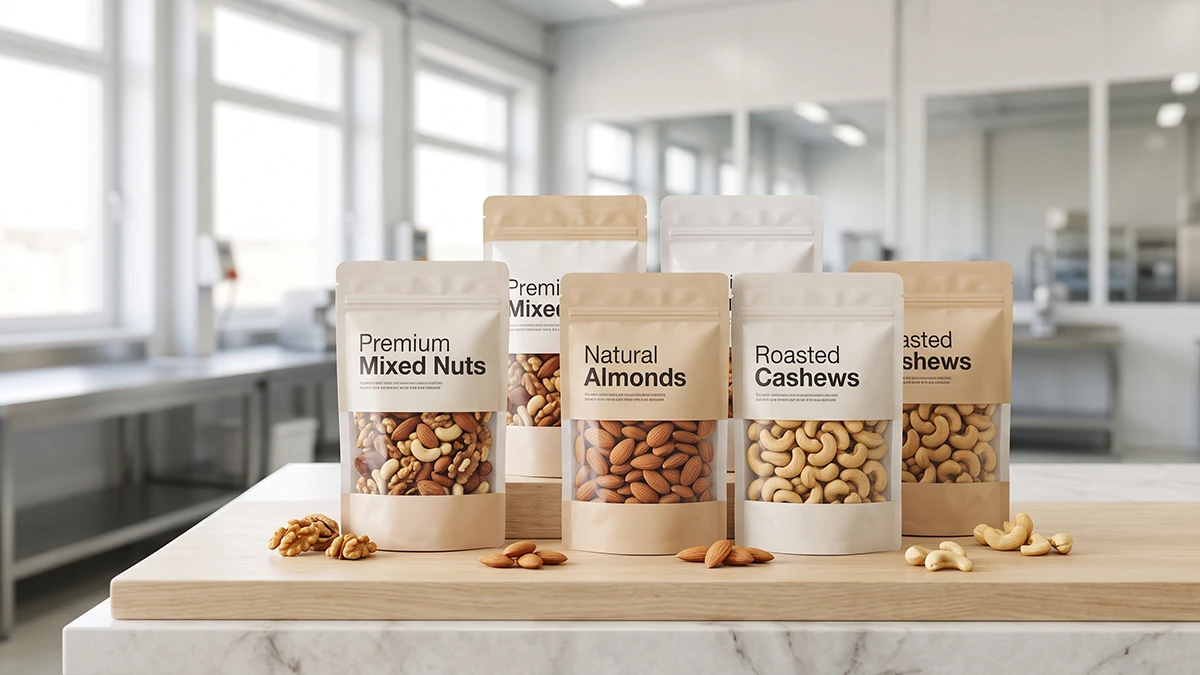
- Snacks and confectionery: puffed food, potato chips, dried fruit, nuts, biscuits, pet treats, frozen vegetables
- Agricultural goods: rice, grains, beans, seeds, coffee beans, specialty produce
- Seasonings: chicken bouillon granules, coarse salt, rock sugar, MSG
- Pharmaceutical and nutraceutical: herbal slices, tablets, capsules, supplements
- Hardware and components: small screws, plastic fasteners, electrical connectors
If your product tends to clump, bridge, or vary widely in piece weight, share a sample with our engineering team before finalizing the configuration. Dosing behavior on the weigher matters more than the product category itself.
Utilities and Floor Requirements
Three site items are worth confirming before the purchase order moves forward.
Ceiling clearance. The system stands 3.6 m from the floor to the top of the weigher discharge funnel. Low-ceiling workshops sometimes need the layout adjusted or a raised opening in the building.
Compressed air. Operating pressure is 0.8 MPa at roughly 0.3 m³/min. A dedicated compressor rated at 1.0 m³/min or above is recommended so the line is not starved when other equipment cycles on.
Power. Total consumption is about 4.5 kW. Voltage is specified as 220V or 380V three-phase at 50 or 60 Hz, and can be matched to your regional electrical standard at the ordering stage.
Controls, Safeguards, and Options
The PLC and HMI touchscreen cover recipe management, runtime diagnostics, and multilingual display, so operators can switch between product recipes without mechanical re-setting.
Two safeguards matter from an operating cost standpoint. The “no bag – no fill – no seal” logic uses optical and mechanical sensors to prevent product discharge and jaw contamination when a pouch is missing or misfed. Interlocked transparent safety doors stop mechanism motion the moment they are opened.
Modules that buyers frequently add at the quotation stage:
- Batch and date coding: hot ribbon stampers, thermal transfer overprinters (TTO), or continuous inkjet (CIJ) units
- Gas flushing: nitrogen purge for modified atmosphere packaging (MAP) to extend shelf life
- Zipper opening and re-closing modules for resealable pouches
- Dust extraction manifold around the filling funnel for fine powders and dry granules
- Downstream equipment: take-away discharge conveyors, inline checkweighers, and metal detectors
For weight verification and compliance-driven QC, the checkweigher is usually the item buyers regret delaying, since it is easier to integrate at build time than to retrofit.
FAQ
What packing speed can I realistically expect?
Expect 20 – 60 bags/min, with the actual rate determined by your material characteristics and dose weight. Light, free-flowing products with consistent piece weight run toward the upper end; sticky or irregular products run lower. The reliable way to confirm your figure is a trial with your own product and pouch.
Can one machine handle several bag sizes and formats?
Yes. The adjustable gripper covers pouch lengths of 80 – 350 mm and widths of 70 – 250 mm, and the platform runs stand-up pouches, 3-side and 4-side seal bags, zipper pouches, and pillow bags. Changeover involves mechanical adjustment rather than a dedicated machine per format.
What should I prepare before installation?
Confirm three site conditions first:
- Ceiling or truss clearance above 3.6 m for the full system height
- A dedicated air compressor supplying at least 1.0 m³/min at 0.8 MPa
- Three-phase power at 220V or 380V, matched to your local standard
Does the system support nitrogen flushing and date coding?
Yes, both are available as options. A nitrogen purge system supports modified atmosphere packaging for shelf-life extension, and coding can be handled by a hot ribbon stamper, a thermal transfer overprinter, or an inkjet unit.
Is the machine suitable for pharmaceutical or hardware products?
Yes, within its dosing range. It runs tablets, capsules, herbal slices, and supplements, as well as small screws, fasteners, and electrical connectors. For these categories, product contact zones in SUS304 or SUS316 stainless steel and an inline metal detector are commonly specified together.
To discuss your product, pouch format, and target output with our packaging engineers, send us your requirements here. A product sample and a target bags-per-minute figure are usually enough for a useful first assessment.