Automation in food packaging refers to the use of mechanical, electronic, and software-based systems to perform packaging operations with minimal human intervention — from semi-automatic filling stations to fully integrated lines handling weighing, bagging, labeling, case packing, and palletizing without manual touchpoints. For food manufacturers, adoption is becoming a competitive necessity driven by labor shortages, rising food safety standards, and margin pressure that manual operations cannot absorb.
If you are still relying on hand-weighing or manual bag sealing, you know the pain points: inconsistent output, difficulty retaining line workers, and the constant worry about audit findings in your traceability or hygiene protocols. Every missed seal and inaccurate fill weight chips away at profitability. The question is where to start and how far to go. This guide covers the technologies, equipment, costs, and strategic considerations to help you decide.
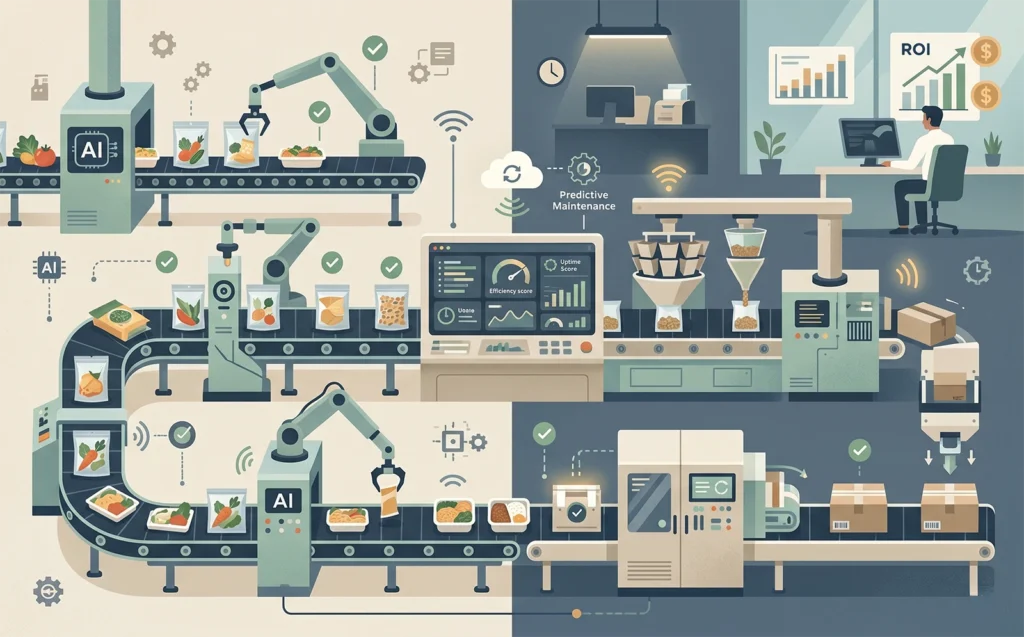
What Is Automation in Food Packaging and Why Does It Matter?
Automation in food packaging means replacing manual processes with mechanized systems that operate consistently and accurately regardless of shift timing or operator fatigue. These range from a single automatic bagging machine to fully integrated platforms where product flows from processing into packaging, labeling, inspection, and palletizing with minimal human contact. The core value is repeatability — every package formed, filled, sealed, and labeled the same way.
The Operational Drivers Behind Adoption
Food manufacturers automate packaging for three primary reasons. Labor tops the list — packaging roles have high turnover, and finding reliable line workers is increasingly difficult. Automation eliminates dependency on manual labor for repetitive tasks. Second is throughput consistency: a manual line producing 30 bags per minute might drop to 22 by end of shift, while an automated system holds its rated speed. Third is food safety compliance — automated lines reduce human contact points, integrate in-line inspection, and generate traceability data that auditors demand.
The Business Case Beyond Cost Reduction
While labor savings are the headline metric, the real return often comes from less obvious sources. Reduced product giveaway — a multi-head weigher hitting ±1 gram accuracy instead of ±5 grams manually — can save thousands monthly on high-value ingredients. Lower rework and waste rates reduce material loss. Faster changeover times support shorter production runs, enabling greater product variety. Automation shifts packaging from a cost center to a capability enabler.
Automation in food packaging is not a single technology purchase but a strategic decision about how your line operates and scales. The right approach depends on your product type, volume, and facility constraints.
Key Takeaway: Automation in food packaging addresses labor, consistency, and compliance simultaneously — but the strongest financial returns often come from waste reduction and changeover flexibility, not just headcount savings.
Types of Automation Systems Used in Food Packaging
Automation systems in food packaging span from standalone semi-automatic machines to fully integrated platforms. Understanding the categories helps buyers evaluate what fits their operation and growth plans.
Semi-Automated Systems
Semi-automated equipment requires an operator to perform certain actions — loading product into a filling station or initiating a seal cycle — while the machine executes the core function automatically. These systems suit smaller facilities, specialty lines, or operations with frequent changeovers where full automation is impractical. The investment is lower and the operator retains pacing control, but throughput still depends on human speed and the line cannot run unattended.
Fully Automated and Integrated Lines
Fully automated systems handle every step from product intake to finished pallet without manual intervention. Sensors detect product arrival, filling heads adjust portion sizes, seal temperatures self-regulate, checkweighers reject off-target packages, and robotic arms palletize completed cases. These lines are typical in high-volume facilities with stable product lines. Per-unit costs drop dramatically at steady operation, but integration complexity increases as more machine types are linked — making compatible equipment from a single supplier or integrator important.
Control System Architecture
Every automated line relies on a control hierarchy. Programmable logic controllers (PLCs) manage individual machine cycles. A SCADA layer monitors line-wide performance and alerts operators to deviations. Human-machine interface (HMI) panels let operators adjust parameters and view real-time status. The sophistication of this layer determines how easily the line integrates with plant systems and how much data is available for analysis.
- PLCs and Machine Control: Each machine has its own PLC managing specific sequences, communicating with upstream and downstream equipment via industrial protocols for coordinated start-stop and jam prevention.
- SCADA and Line Supervision: Collects throughput rates, downtime events, and reject counts into a unified dashboard essential for production reporting.
- HMI and Operator Interface: Touchscreen HMIs allow recipe changes, timing adjustments, and fault diagnosis — well-designed interfaces reduce training time and changeover errors.
The right system type depends on your volume, product variability, and budget. Many facilities start with semi-automatic equipment on their most problematic line and expand toward full integration as capability grows.
Key Takeaway: Automation systems range from semi-automatic stations to fully integrated lines, and the control architecture — PLC, SCADA, HMI — determines how effectively the equipment performs, integrates, and reports.
Key Food Packaging Machines in an Automated Production Line
An automated food packaging line consists of several discrete machine types, each handling a specific function. Understanding how they interact helps buyers configure a line that balances speed, accuracy, and flexibility.
Filling and Dosing Equipment
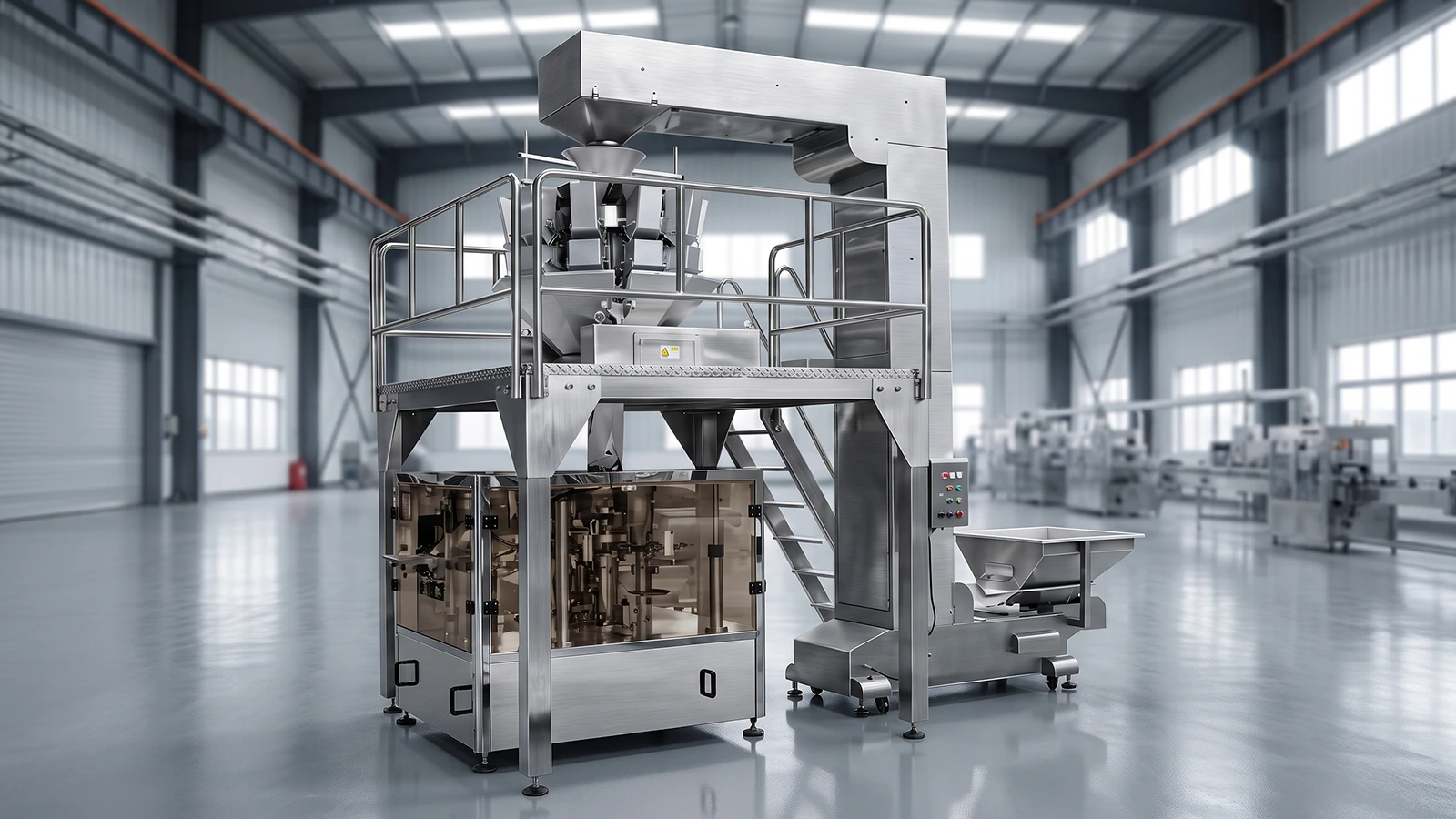
Filling machines deliver precise product quantities into each container. Volumetric fillers work well for free-flowing granular products like rice or beans. Multi-head weighers are standard for snacks and frozen vegetables — they combine weigh buckets to achieve high speed with excellent accuracy. Liquid fillers handle everything from water to viscous sauces using piston, gravity, or pump systems. For sticky or irregular products, specialized dosing prevents bridging and weight variation that causes giveaway.
Sealing and Closing Machines
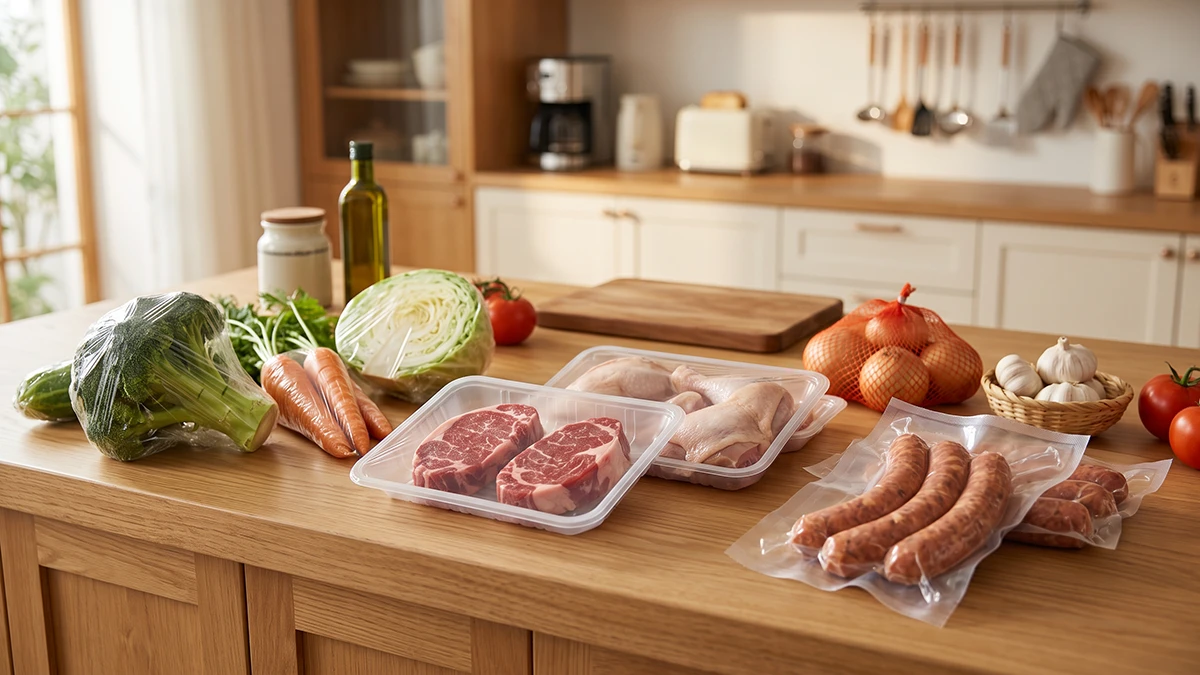
Sealing protects the product and prevents contamination. Continuous band sealers are common for pillow bags and pouches. Tray sealers handle modified atmosphere packaging (MAP) for fresh meats and prepared meals, replacing air with a gas mixture that extends shelf life. Vacuum packaging machines remove air for products where oxidation is a concern. Cap tighteners serve rigid containers like jars and bottles. Each method must match both the packaging material and the product’s preservation requirements.
Labeling, Coding, and Inspection Systems
Labeling machines apply labels with consistent placement. Wrap-around labelers handle cylindrical containers; pressure-sensitive labelers work on flat or irregular surfaces. Print-and-apply systems generate variable data labels — batch codes, barcodes — directly on the line. In-line inspection equipment including checkweighers, metal detectors, and vision systems verifies each package before it moves downstream.
- Checkweighers: Confirm declared weight, reject underweights, and flag overweights to reduce giveaway.
- Metal Detectors and X-Ray Systems: Identify contaminants. X-ray also detects glass, stone, and dense plastic — often mandatory under retailer requirements.
- Vision Inspection: Camera systems verify label presence, print quality, and seal integrity. Reject trends provide early warning of upstream issues.
Case Packing and Palletizing Equipment
End-of-line machines pack primary packages into shipping cases and arrange them onto pallets. Robotic palletizers stack cases in predefined patterns for load stability. Stretch wrappers secure palletized loads for transport. In high-volume facilities, these machines eliminate the most physically demanding segment of the packaging line.
A well-configured line flows product smoothly with buffer zones that absorb minor speed variations between stations.
Key Takeaway: Core machines — fillers, sealers, labelers, inspection units, and case packers — must be selected as a coordinated system, not isolated purchases, to avoid bottlenecks and compatibility issues.
How Automated Packaging Lines Improve Food Safety Compliance
Food safety requirements are tightening globally, with retailers demanding verifiable proof of hygiene and traceability standards. Automated packaging lines provide structural advantages that manual operations cannot match.
Reducing Contamination Risk Through Reduced Human Contact
Every human touchpoint introduces contamination risk. Automated lines minimize these touchpoints by design — product flows through enclosed chutes, filling occurs in sealed environments, and inspection happens without handling. For high-risk categories like ready-to-eat meals and fresh protein, this reduction in contact is often the difference between passing and failing a third-party audit. Many automated lines also incorporate wash-down rated construction (IP65 or higher) for thorough cleaning.
Traceability and Lot Control
Manual traceability depends on paper logs and operator discipline — both prone to error under pressure. Automated systems generate digital records automatically. Every packaging cycle is timestamped and linked to batch, shift, and equipment parameters. When a quality issue is detected, the line identifies which production interval and machine settings produced the affected packages — precision increasingly required by regulations like the FSMA Traceability Rule and EU Food Information Regulation.
| Capability | Manual Line | Automated Line |
|---|---|---|
| Lot tracking | Paper logs, operator-dependent | Digital, automatic, timestamped |
| Contamination detection | Visual inspection, periodic | Continuous in-line metal/X-ray check |
| Seal integrity verification | Spot-check, destructive test | Continuous monitoring with reject |
| Cleaning validation | Visual confirmation | Documented CIP/SOP cycles |
| Audit trail generation | Manual compilation | Automated report generation |
Consistent Seal and Package Integrity
Package integrity failures are a direct food safety risk. Automated sealers maintain consistent temperature, pressure, and dwell time across every cycle — parameters manual sealing cannot match. Continuous monitoring flags drift before defective packages are produced. In MAP applications, automated gas flushing maintains precise oxygen and CO₂ levels, and in-line analyzers verify every package. This turns HACCP critical control points from periodic checks into continuous verification.
Automated lines do not eliminate the need for food safety protocols, but they make those protocols measurable, auditable, and less dependent on human vigilance.
Key Takeaway: Automation transforms food safety compliance from a reactive, paper-based exercise into a continuous, data-backed process — reducing contamination risk and producing audit-ready records as a natural output of production.
Automation in Primary, Secondary and End-of-Line Packaging
Food packaging automation is typically discussed in three stages, each with different equipment requirements and ROI characteristics.
Primary Packaging Automation
Primary packaging directly contacts the food — the bag, tray, bottle, or can consumers see on the shelf. Automation at this stage focuses on fill accuracy, seal integrity, and speed using multi-head weighers, form-fill-seal machines, and tray sealers. Because these machines handle food directly, they must meet stringent hygiene standards with wash-down construction and stainless steel contact surfaces. Investment here typically delivers the fastest payback by directly reducing giveaway and improving first-pass quality.
Secondary Packaging Automation
Secondary packaging groups primary packages into cartons, cases, or shrink-wrapped bundles for distribution. Case packers, cartoners, and shrink wrap tunnels handle this stage, operating at slightly lower speeds but often managing output from multiple primary machines. Secondary automation reduces labor significantly — manual case packing is one of the most physically demanding jobs on a line — and improves retail-ready presentation quality.
End-of-Line Palletizing and Logistics
End-of-line automation covers palletizing, stretch wrapping, and sortation. Robotic palletizing has become cost-accessible for mid-volume facilities, with collaborative robots competing with traditional gantry systems. Automated palletizing produces stable, uniform loads that survive transport better than hand-stacked pallets. Integrated labeling systems apply shipment labels that connect with warehouse management systems.
- Robotic Palletizing: Articulated arms for high speeds and heavy loads; collaborative robots for space-constrained facilities.
- Stretch Wrapping: Automated wrappers apply consistent tension, reducing film usage by 20–40% versus hand wrapping.
- Pallet Labeling: Print-and-apply systems transmit data to WMS and ERP, eliminating manual data entry at the shipping dock.
Manufacturers achieving the highest OEE automate across all three stages in a coordinated sequence, starting with the bottleneck that constrains overall output.
Key Takeaway: Primary, secondary, and end-of-line automation serve different functions — sequencing investments from the bottleneck outward produces better outcomes than automating all three stages simultaneously.
How to Choose the Right Level of Packaging Automation
Selecting the right automation level is not binary between manual and fully automatic. It depends on production characteristics that vary between facilities and even between SKUs.
Evaluating Production Volume and Product Mix
A line running one or two SKUs at high volume (60+ packages per minute) is a strong candidate for full automation — capital spreads across millions of packages annually. A facility running 50 SKUs in small batches faces a different calculation. Frequent changeovers make full automation expensive unless the equipment is designed for rapid format changes. Semi-automatic machines with quick-release tooling and recipe-based adjustment often provide better TCO in high-mix environments. Seasonality matters too — facilities that peak during harvest or holiday periods benefit from automation that handles surges without temporary labor.
Budget, Scalability, and Facility Constraints
The more relevant question than budget is how investments scale. Modular equipment that starts semi-automatic and upgrades to full automation as production grows offers a lower-risk path. Facility layout matters — older buildings with low ceilings or inadequate electrical capacity may require infrastructure investment that changes project economics. Compressed air quality, wash-down water availability, and network connectivity should be assessed before equipment selection.
| Factor | Favors Semi-Automation | Favors Full Automation |
|---|---|---|
| Production volume | Under 1M units/year | Over 5M units/year |
| SKU count | 20+ | Under 10 |
| Changeover frequency | Multiple times daily | Weekly or less |
| Labor availability | Stable workforce | Chronic shortages |
| Product characteristics | Irregular, fragile, variable | Uniform, free-flowing, stable |
The Hybrid Approach
Many experienced operations run a hybrid model — fully automated primary packaging with semi-automatic case packing, or automated palletizing downstream of a manual packing station. This targets investment at the most painful part of the line while leaving flexibility where full automation is uneconomical. The hybrid model also builds technical capability gradually before committing to a fully integrated line.
A thorough line audit — measuring actual throughput, downtime causes, changeover time, and reject rates — provides the data to decide.
Key Takeaway: Choosing the right automation level requires balancing volume, mix, budget, and facility constraints — for many operations, a hybrid approach targeting specific bottlenecks outperforms either extreme.
ROI of Food Packaging Automation: Costs, Savings and Payback
Building a realistic ROI model requires looking beyond labor replacement. Costs include equipment, installation, integration, training, and maintenance. Savings extend across multiple categories.
Upfront Investment and Installation Costs
A single semi-automatic VFFS machine might range from 15,000 to 50,000. A fully integrated line with multi-head weigher, bagger, checkweigher, case packer, and palletizer typically falls between 250,000 and 1,500,000. Installation adds 10–20% for mechanical and electrical work. Integration costs — linking to plant systems, configuring SCADA — add another 5–15%. These figures vary by region and supplier, but the proportions remain consistent.
Quantifying the Savings
Labor reduction is the most visible saving. A line requiring six operators per shift on two shifts might run with two after automation, saving 80,000–150,000 annually depending on local rates. But other savings often match or exceed labor.
- Product Giveaway Reduction: A multi-head weigher improving fill accuracy by 3 grams per package on a 2 million-unit line saves 6,000 kg of product annually — 30,000 at 5/kg.
- Material Waste Reduction: A 1% lower reject rate on a 5 million-unit line saves 50,000 packages worth of material.
- Changeover Time Savings: Reducing changeovers from 45 to 10 minutes with 10 changeovers per week recovers nearly 300 hours of productive time annually.
- Quality Claim Reduction: Consistent packaging reduces retailer chargebacks and complaint management costs.
Payback Period Realities
Most food packaging automation projects target payback between 18 and 36 months. A project that looks marginal on labor savings alone often becomes compelling when giveaway reduction and quality claim avoidance are factored in.
- 18–24 months: High-volume lines with significant labor and giveaway savings. Typical for snacks, frozen foods, and dry goods.
- 24–36 months: Medium-volume lines or projects requiring facility modification. Common in beverage, dairy, and fresh protein.
- 36–48 months: Low-volume specialty lines driven primarily by compliance rather than economic return.
Key Takeaway: Realistic ROI modeling must include giveaway reduction, material waste savings, changeover efficiency, and quality claim reduction — not just labor — to capture the full financial picture.
Common Challenges When Implementing Packaging Automation
Even well-planned projects encounter obstacles. Anticipating them before signing a purchase order reduces delays and cost overruns.
Integration with Existing Equipment and Controls
A new automated line must connect to upstream processing and plant-wide control systems. Compatibility issues arise when equipment from different manufacturers uses different communication protocols — a filler on EtherNet/IP may struggle with a case packer using Profinet unless integration is planned at the specification stage. Engaging a supplier providing compatible equipment across the full line prevents the most common source of commissioning delays.
Technical Skill Requirements and Training Gaps
Automated lines require different skills. Operators need to understand HMI screens and basic troubleshooting. Maintenance staff need competence in PLC logic and servo drive tuning — skills traditional mechanical fitting does not cover. Facilities that underestimate training see higher downtime in the first six months. Budgeting for formal training, internal SOPs for common faults, and an after-service agreement during ramp-up mitigates this risk.
Changeover Complexity and Line Flexibility
Rapid changeover capability varies significantly between equipment designs. A bagger with toolless film loading and recipe-based parameter recall might change over in under five minutes; the same machine with bolted tube changes could take 30. The overall line speed is determined by the slowest changeover, so balancing flexibility across all machines is essential.
- Mechanical changeovers: Physical replacement of forming tubes or seal jaws. Toolless systems reduce time by 50–70%.
- Parameter changeovers: Temperature, speed, and timing adjustments. Recipe storage with one-button recall eliminates lookup errors.
- Material changeovers: Film and label changes. Automated splicing reduces downtime for continuous-motion machines.
Supplier Communication and After-Sales Support
Every hour of downtime affects delivery commitments. Buyers should evaluate suppliers on spare parts availability, response time guarantees, and remote diagnostic capability. Suppliers like Reliancepak offering remote diagnostics, stocked spares, and structured training reduce extended downtime risk. Confirming support terms — response windows and on-site service rates — before purchase prevents costly surprises.
Key Takeaway: Integration compatibility, operator training, changeover speed, and after-sales support are the four areas where automation projects most commonly encounter delays — addressing them at the specification phase reduces commissioning risk.
Smart Packaging Automation Technologies and Industry 4.0
Industry 4.0 refers to integrating digital technologies — connectivity, data analytics, intelligent control — into manufacturing operations. In food packaging, this is changing how lines are monitored, maintained, and optimized.
Industrial IoT and Real-Time Data Collection
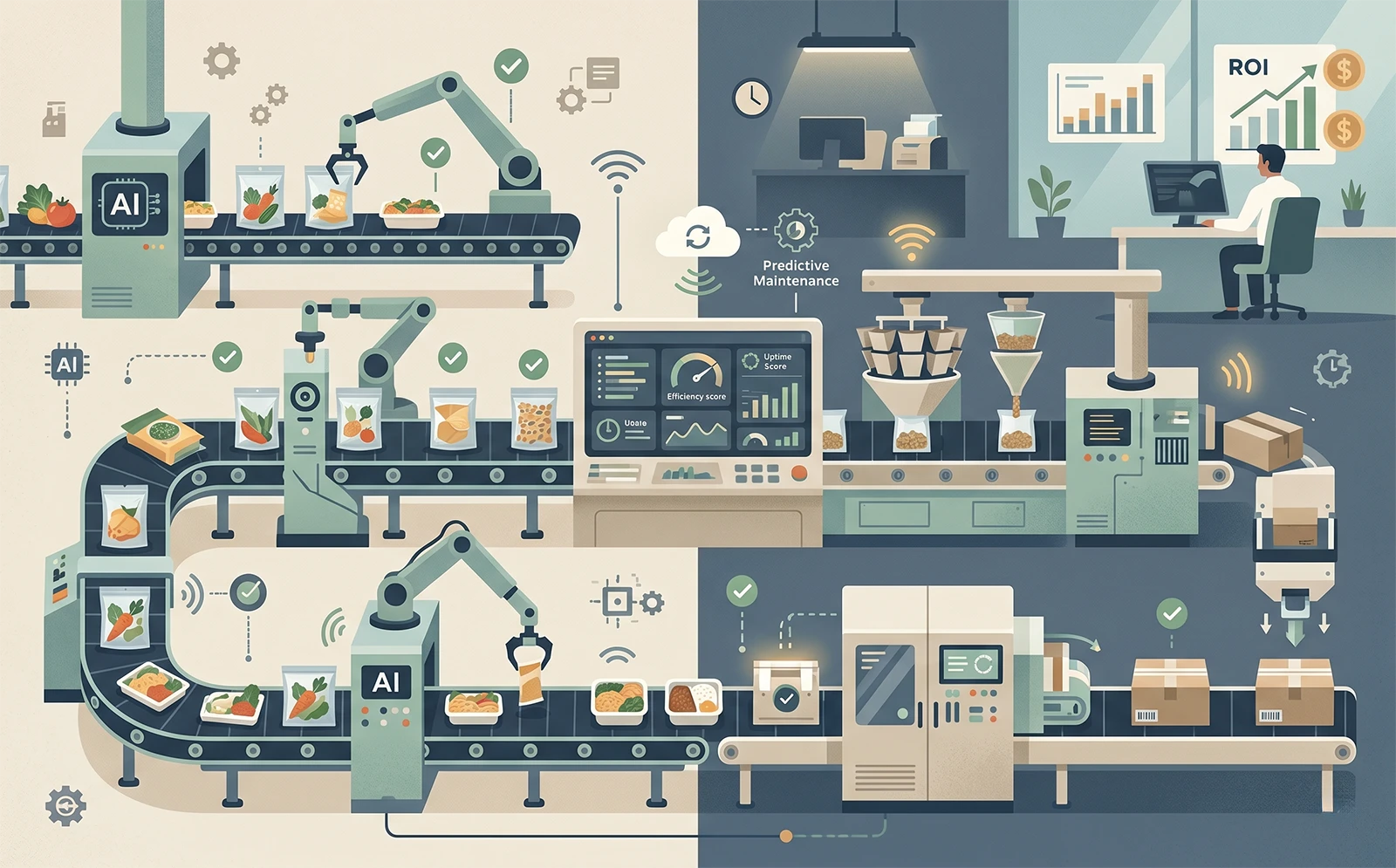
Modern packaging machines generate operational data as a byproduct of their control systems. IIoT connectivity transmits this to central platforms where it becomes actionable. Production managers see real-time OEE across all lines from a single dashboard. Maintenance teams receive alerts when parameters drift outside normal range. Quality teams access seal temperature records and checkweigher trends without walking the line. The value is in response speed — gradual weight drift can be corrected at the next changeover rather than after a batch of out-of-spec packages has been produced.
Predictive Maintenance and Downtime Reduction
Unplanned downtime is the largest source of lost productivity on automated lines. Predictive maintenance uses machine data to forecast component failure before it happens — vibration sensors on bearings, current draw monitoring on servo motors, temperature trends on seal bars. The shift from reactive repair to condition-based maintenance reduces both frequency and duration of downtime. Implementation requires sensors, edge or cloud connectivity, and a maintenance team trained to act on insights.
Digital Twins and Simulation
A digital twin is a virtual replica of the physical packaging line that mirrors its behavior in real time. Engineers use simulation to test changeover sequences, optimize line balancing, and evaluate equipment additions without stopping production. Digital twin technology was traditionally limited to large manufacturers, but cloud-based platforms are making it accessible to mid-market facilities.
- Line Simulation: Test throughput scenarios and bottleneck impacts virtually before physical changes.
- Remote Monitoring: View line performance and production KPIs from off-site locations.
- Automated Reporting: Generate daily OEE and quality summaries without manual data entry.
The payback from reduced downtime alone is typically under 12 months.
Key Takeaway: Industry 4.0 technologies — IIoT monitoring, predictive maintenance, digital simulation — convert packaging lines from static assets into continuously optimizing systems.
Automation Solutions for Different Food Manufacturing Sectors
Food manufacturing is not a single industry. Packaging requirements for fresh poultry differ fundamentally from those for cereal or bottled juice. Suppliers that understand sector-specific needs provide configurations that match actual production constraints.
Fresh and Perishable Foods
Fresh meat, poultry, seafood, and prepared meals require packaging that preserves quality under strict hygiene standards. Modified atmosphere packaging is dominant, with tray sealers and thermoformers creating gas-flushed packages that extend chilled shelf life. Equipment must withstand frequent wash-down with aggressive sanitizers — stainless steel, IP69K-rated components, and sloped drainage surfaces are standard. Speeds are moderate (15–40 ppm) due to irregular product shapes.
Dry Goods and Snack Foods
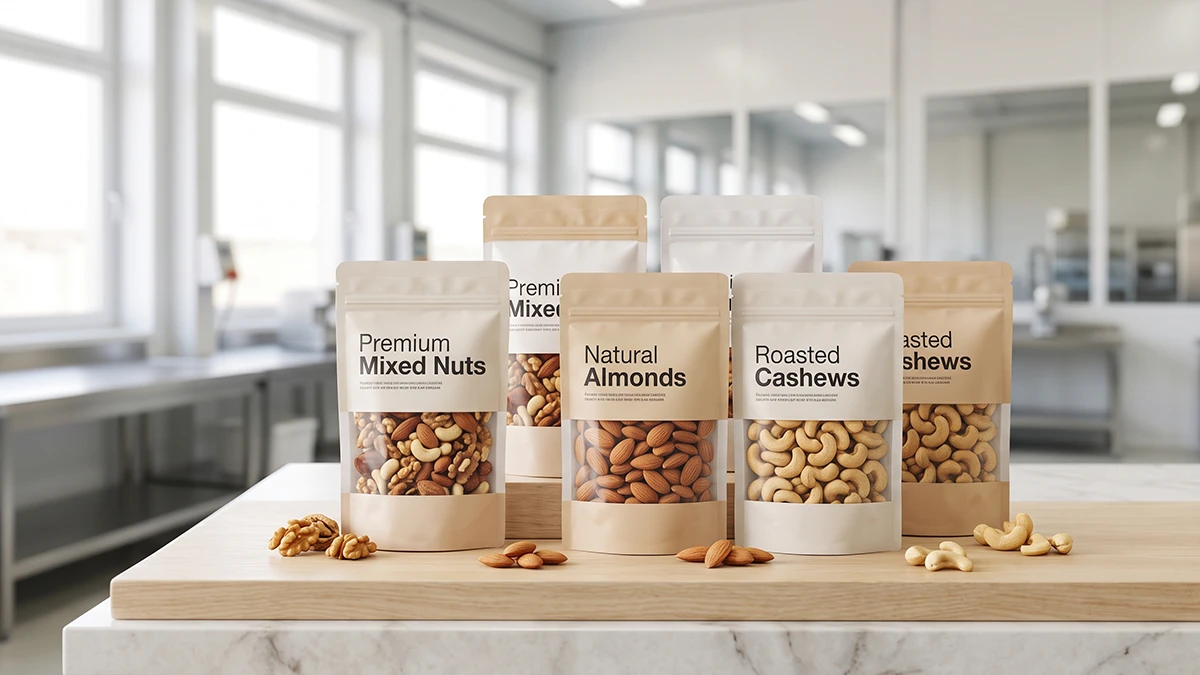
Chips, nuts, grains, and coffee are among the most automated categories. Multi-head weighers feeding vertical form-fill-seal baggers achieve 60–120 bags per minute. Key challenges are dust management, static electricity affecting film handling, and seal quality despite product particulates. Nitrogen flushing is commonly integrated for shelf life extension. Equipment runs dry, avoiding the wash-down specifications of the fresh sector.
Beverages and Liquid Products
Bottled water, juices, sauces, and edible oils require filling equipment that handles foaming, viscosity, and drip prevention. Piston, gravity, and flowmeter-based fillers are selected based on product characteristics. Downstream packaging includes wrap-around labelers and case packers designed for container geometries. High-speed lines can run 200+ containers per minute, demanding conveyor synchronization and reject accuracy that mid-speed lines do not face.
Frozen Foods
Frozen vegetables, fish, and ready meals present the challenge of packaging below freezing. Ice accumulation affects sealing and sensor accuracy. Product bridging in weigher buckets causes downtime. Equipment requires heated seal bars, anti-ice coatings, and climate-controlled electrical cabinets. Many lines use VFFS with extended cooling zones on seal bars to prevent product thaw at the seal interface.
| Sector | Primary Machine Type | Typical Speed | Key Challenge |
|---|---|---|---|
| Fresh protein | Tray sealer, thermoformer | 15–40 ppm | Wash-down sanitation |
| Snacks / dry goods | VFFS + multi-head weigher | 60–120 ppm | Dust and static control |
| Beverages | Piston / gravity filler | 100–300 ppm | Container handling at speed |
| Frozen foods | VFFS with heated sealing | 40–80 ppm | Ice buildup and bridging |
Key Takeaway: Packaging automation requirements differ substantially by food sector — equipment that performs well for snacks may not meet the hygiene demands of fresh protein or the cold challenges of frozen food.
How to Select a Food Packaging Automation Supplier
Supplier choice is as important as equipment choice. A well-built machine from a supplier with poor support causes more frustration than a simpler machine backed by responsive service.
Evaluating Technical Capability and Product Range
Suppliers with a broad product range provide compatible equipment across primary, secondary, and end-of-line stages, reducing integration risk. A supplier manufacturing baggers, checkweighers, and case packers has a strong incentive to ensure those machines communicate reliably. Specialists may offer deeper expertise in a single machine type, but the buyer then acts as integrator — a role many food manufacturers lack resources to fill. Ask about reference installations in your specific sector.
After-Sales Support and Spare Parts
Geographic distance from the supplier’s service base matters. Local representation, stocked spare parts, and remote diagnostic capability reduce extended downtime risk. Request the supplier’s commitment on same-day dispatch for critical items and lead times for non-stocked components. Training should cover both operator-level interface use and maintenance-level troubleshooting, ideally at your facility using your product and materials.
- Spare Parts Strategy: Confirm which parts are stocked locally and typical lead times. Machines relying on custom-machined parts from overseas for routine items introduce unnecessary downtime risk.
- Remote Support Capability: Remote diagnostics resolve many control issues without dispatching a technician, reducing cost and response time.
- On-Site Commissioning: Verify the quoted price includes on-site installation supervision. Machines that perform at the factory often need adjustment with your specific utilities and product.
Customization vs. Standard Equipment
Standard machines cost less, ship faster, and have proven reliability. Customized machines address specific handling requirements but introduce development risk and longer lead times. The pragmatic approach is standard equipment wherever possible, reserving customization for infeed conveyors, control integration points, and product contact surfaces. Suppliers like Reliancepak offering customization alongside standard product lines provide flexibility without requiring a fully bespoke approach.
Key Takeaway: Supplier selection should prioritize sector references, spare parts availability, remote diagnostics, and realistic customization policies — not just machine specifications and price.
Future Trends in Food Packaging Automation for 2026 and Beyond
The direction of food packaging automation is shaped by labor pressure, regulatory evolution, sustainability demands, and falling technology costs.
AI and Machine Vision Evolution
Traditional vision systems detect missing labels based on fixed rules. AI-based systems learn what acceptable variation looks like and adapt without reprogramming. This matters because natural products vary in appearance — a potato chip line produces irregular shapes that trigger false rejects in traditional systems. AI vision reduces false rejects while improving genuine defect detection. Expect it to become standard on new inspection equipment within two years.
Sustainable Packaging Adaptation
As manufacturers transition to recyclable mono-materials and compostable films, machinery must adapt. Mono-materials seal differently than multi-layer laminates — they need narrower temperature windows and different seal jaw treatments. Compostable films are more sensitive to humidity. Equipment manufacturers are developing seal systems with finer temperature control and adaptive pressure compensation. Facilities investing in flexible sealing today will have an easier time switching materials as sustainability requirements evolve.
Collaborative Robotics at Scale
Collaborative robots gained traction in secondary and end-of-line applications. The next wave brings cobots into primary packaging — loading trays, placing interleaving sheets, handling flexible materials. Cobots are easier to redeploy than fixed automation, suiting facilities with seasonal patterns. As payload capacity increases and programming complexity decreases, they will fill the gap between manual operations and dedicated high-speed automation.
- Cobot Packing Cells: Compact and re-deployable between lines. Payloads now reach 15–20 kg, sufficient for most secondary tasks.
- Mobile Manipulators: Cobots on autonomous platforms that move between stations. Still early-stage but promising for intermittent automation needs.
- Simplified Programming: No-code interfaces with drag-and-drop sequencing reduce the skill barrier for plant personnel.
Data Integration and Supply Chain Connectivity
The next frontier is how line data connects to the broader supply chain. Real-time production data feeding into inventory management and retailer replenishment systems reduces buffer stock. When a retailer’s system sees your line is running to schedule, lead time buffers shrink. The efficiency gains are substantial for manufacturers serving major retail customers.
The facilities that will lead are those with the most effective integration between their packaging lines, quality systems, and supply chain partners.
Key Takeaway: The next phase of food packaging automation will be defined by AI vision, adaptive sealing for sustainable materials, re-deployable cobots, and deeper supply chain data integration.
Bringing It Together: Building Your Automation Roadmap
The decision to automate requires balancing production volume, product characteristics, budget, facility conditions, and workforce readiness. The most successful projects start with a clear understanding of current line constraints and a realistic vision of where the operation needs to be in three to five years.
Reliancepak, operating through its Autopackline brand, provides semi-automatic and fully automatic packaging equipment across primary, secondary, and end-of-line stages — covering bagging, filling, sealing, labeling, and case packing with customization services available. Whether you are installing your first automatic station or commissioning a fully integrated line, discussing your application with an experienced supplier clarifies the practical path forward.
The industry is moving toward greater automation, tighter food safety integration, and smarter data utilization. Manufacturers who invest strategically — with clear priorities, realistic budgets, and the right supplier partnerships — will emerge with lower costs, better compliance, and stronger competitive positions.
Frequently Asked Questions
How much does it cost to automate a food packaging line?
A single semi-automatic machine starts around 15,000. A fully integrated line with weighers, baggers, checkweighers, case packers, and palletizers typically ranges from 250,000 to $1,500,000 depending on complexity and speed.
Can I automate packaging for multiple product types on one line?
Yes, if the equipment is designed for rapid changeover. Machines with recipe-based controls, toolless forming tube changes, and adjustable conveyor guides can handle multiple SKUs. High-mix lines generally operate at lower speeds than dedicated single-product lines.
What is the typical payback period for packaging automation in food manufacturing?
Most projects achieve payback between 18 and 36 months. High-volume lines with substantial labor and giveaway savings often pay back in under 24 months. Specialty or compliance-driven projects may extend toward 48 months.
How do I know if my facility is ready for packaging automation?
Conduct a line audit measuring actual throughput, downtime causes, changeover times, and quality reject rates. If your line operates below 60% OEE or struggles with consistency, automation likely addresses the root cause.
Should I automate one line or all lines at once?
Start with the line that has the highest volume or the most quality issues. Prove the concept on one line, train your team, and apply lessons learned to subsequent lines. Staged implementation reduces risk and builds internal capability.