
Choosing between manual, semi-automatic, and fully automatic packaging equipment is one of the most consequential capital decisions a production facility will make. Get it right, and you unlock years of stable throughput with controlled labor costs. Get it wrong, and you either overpay for idle capacity or watch bottlenecks throttle growth you could have captured.
The challenge is that no single automation tier fits every operation. As explored in our complete guide to packaging automation, the right choice depends on production volume, product diversity, available budget, and physical constraints — factors that shift not only between facilities but often between product lines within the same building.

Understanding the Automation Spectrum
Packaging automation is not a binary switch between manual labor and robotic cells. It is a continuum, and understanding where each option sits helps you match investment to actual need.
Manual packaging relies on human operators for every step — forming, filling, sealing, labeling, and case packing. It works well for very low volumes, artisanal products, or startup operations validating market demand before committing capital.
Semi-automatic machines mechanize the most repetitive or physically demanding steps while keeping operators involved in loading, alignment, or changeover tasks. A semi-automatic tray sealer, for example, requires an operator to place trays and initiate the cycle, but the sealing pressure, temperature, and timing are machine-controlled for consistency.
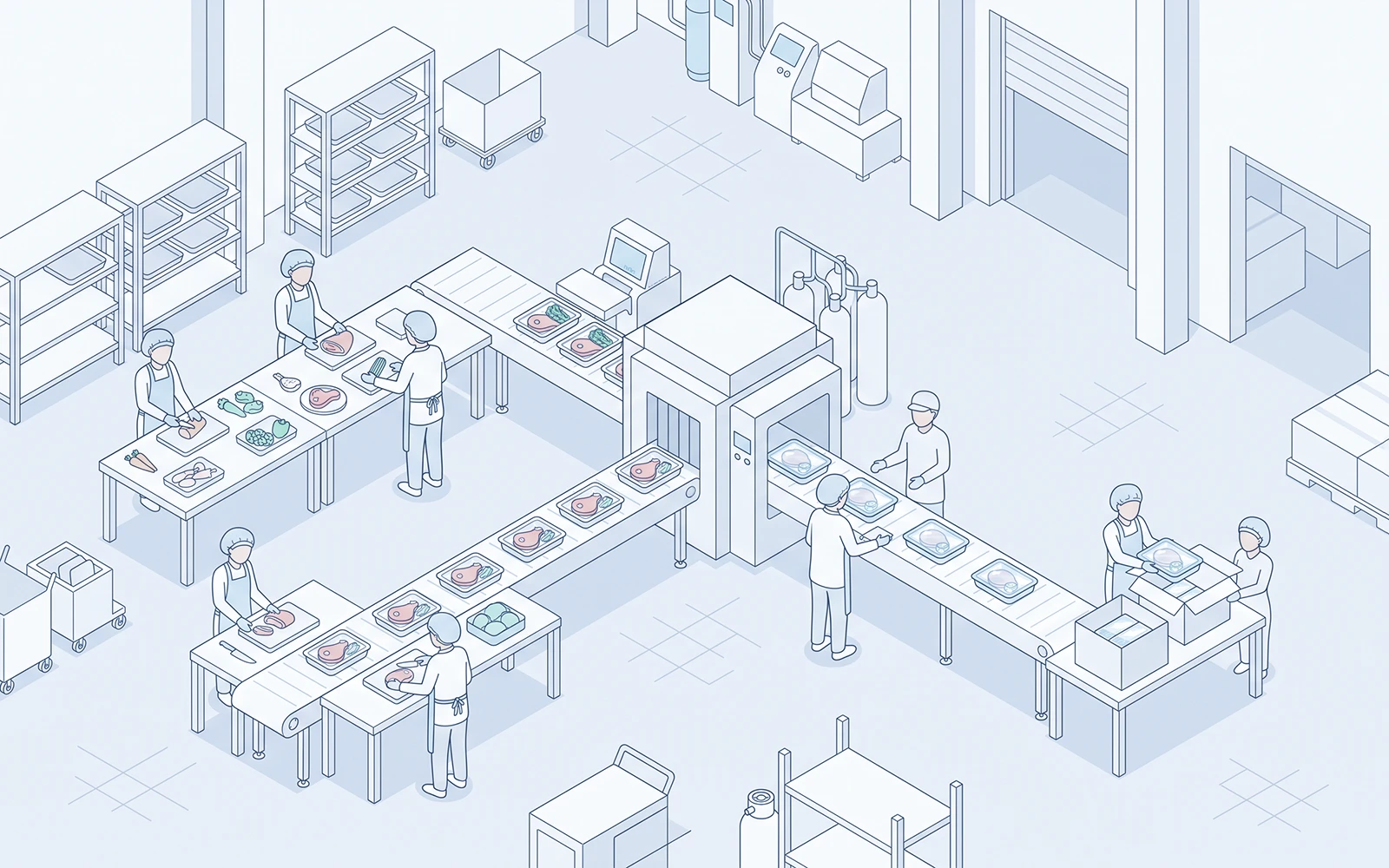
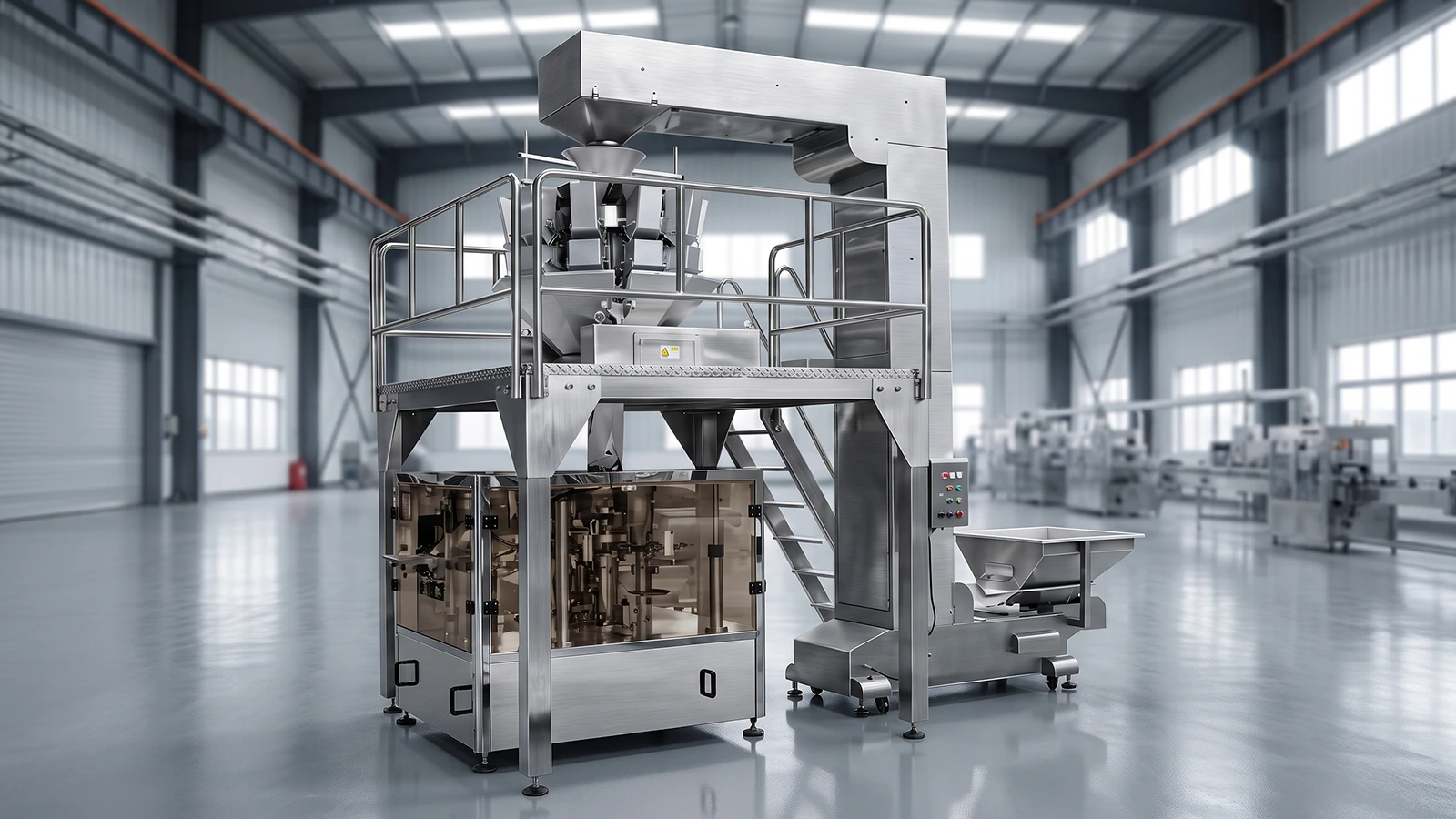
Fully automatic lines handle the entire sequence from product infeed through palletizing with minimal human intervention. These systems justify their cost at sustained high throughput, where the per-unit labor savings compound across millions of packages annually.
Between these poles sit countless configurations. A facility might run a fully automatic filling and sealing front-end feeding into a manual case packing station — a deliberate hybrid that allocates capital where it returns the most.
Evaluating Production Volume and Product Mix
This is the starting point for most automation decisions, and it carries more weight than any other factor.
Single-SKU High-Volume Lines
A line running one or two SKUs at 60 or more packages per minute is a strong candidate for full automation. The capital cost distributes across such a large unit count that the per-package cost drops sharply. Changeovers are rare, so equipment utilization stays high and the return on investment timeline shortens considerably.
High-Mix, Small-Batch Environments
A facility running 50 SKUs in small batches faces a fundamentally different calculation. Frequent changeovers make full automation expensive unless the equipment is specifically designed for rapid format changes — tool-less adjustment, recipe-based servo drives, and quick-release sealing heads.
In these environments, semi-automatic machines with quick-release tooling often deliver a better total cost of ownership. The operator handles the physical changeover while the machine stores parameters for each SKU, keeping cycle times consistent without the premium of fully automated format adjustment.
Seasonality and Demand Spikes
Facilities that peak during harvest or holiday periods face a particular tension. Building automation capacity for peak demand means the equipment sits partially idle for months. Semi-automatic systems that can scale throughput by adding shifts — rather than adding machines — offer a more flexible response to seasonal surges without the carrying cost of underutilized capital equipment.
| Scenario | Recommended Automation Level | Key Consideration |
|---|---|---|
| Single SKU, 60+ ppm | Fully automatic | Capital cost amortized across high volume |
| 5–15 SKUs, moderate volume | Semi-automatic with recipe storage | Balance of flexibility and throughput |
| 50+ SKUs, small batches | Semi-automatic with quick-change tooling | Changeover speed drives TCO |
| Seasonal peak production | Semi-automatic, shift-scalable | Avoid idle capital during off-peak |
Budget, Scalability, and Facility Constraints
The most relevant question is not how much you can spend today — it is how the investment scales as production grows.
Modular Equipment Paths
Modular equipment that starts semi-automatic and upgrades to full automation as production grows offers a lower-risk path. Some manufacturers design their platforms so that a semi-automatic tray sealer can later accept an automatic infeed conveyor, a lid placement module, or a downstream labeling system without replacing the core machine.
This staged approach lets you match capital outlay to demonstrated demand rather than forecasting three years ahead and hoping the volume materializes. It also spreads the technical learning curve — your team builds competence on simpler configurations before operating more complex integrated lines.
Physical Infrastructure
Older buildings with low ceilings, limited floor loading capacity, or inadequate electrical supply may require infrastructure investment that changes the project economics entirely. A fully automatic line that fits easily into a modern purpose-built facility might demand structural modifications, additional HVAC for servo drives, or a compressed air system upgrade in an older building.
These costs are often invisible in the initial equipment quote. A thorough facility assessment — covering compressed air quality, wash-down water availability, three-phase power capacity, and network connectivity for machine-to-machine communication — should precede any equipment selection process.
The Upgrade vs. Replace Decision
If you already operate packaging equipment, the question becomes whether to upgrade existing machines or replace them outright. Upgrading makes sense when the mechanical frame is sound and the limitation is control system age or peripheral integration. Replacement is the better path when maintenance costs are climbing, spare parts availability is declining, or the machine platform cannot support the automation level you need going forward.
The Hybrid Approach
Many experienced operations run a hybrid model — and for good reason. Rather than automating every station on the line, the hybrid approach targets investment at the most constraining bottleneck while leaving flexibility where full automation delivers marginal returns.
Common Hybrid Configurations
A typical hybrid setup might pair fully automated primary packaging — filling, sealing, and labeling — with semi-automatic case packing. The rationale is straightforward: primary packaging demands the highest consistency and runs at the fastest cycle times, making it the most rewarding station to automate. Case packing, by contrast, often involves varied case sizes or mixed-product orders that are difficult to automate economically at moderate volumes.
Another common arrangement places automated palletizing downstream of a manual or semi-automatic packing station. Palletizing is physically demanding work with high injury rates, making it a priority for automation even when upstream stations remain manual.
Building Capability Gradually
The hybrid model also serves as a technical stepping stone. Teams that operate semi-automatic equipment learn the maintenance routines, troubleshooting patterns, and changeover disciplines that fully automatic lines demand. When the business case for further automation matures, the operational foundation is already in place.
This incremental approach reduces the risk that accompanies large capital projects. Instead of a single high-stakes investment in a fully integrated line, you make measured decisions at each stage based on proven performance data from your own facility.
Conducting a Line Audit Before You Decide
Equipment selection without baseline data is guesswork. A structured line audit provides the quantitative foundation for automation decisions and often reveals that the real bottleneck is not where management assumes it is.
What to Measure
A practical audit captures four categories of operational data:
- Actual throughput versus rated capacity — the gap reveals available headroom
- Downtime causes — mechanical failure, changeover, material supply interruptions, or quality holds
- Changeover time — measured from the last good package of one SKU to the first good package of the next
- Reject rates — broken down by defect type to identify whether problems originate from equipment, materials, or operator technique
Using Audit Data to Select Automation Level
The audit findings directly inform which automation tier delivers the best return. If changeover time dominates downtime, quick-change semi-automatic equipment may outperform a fully automatic line that requires lengthy format adjustments. If reject rates trace back to inconsistent sealing pressure or temperature drift, automating the sealing station with closed-loop process control addresses the root cause.
A line audit also establishes the baseline against which you measure post-investment performance — without it, you cannot demonstrate that the capital expenditure delivered its intended improvement.
Working with the Right Equipment Partner
The automation decision is only partly about the machine itself. The supplier’s ability to assess your specific situation, configure equipment to your product mix, and support the system through its operational life often determines whether the investment delivers on its promise.
An experienced packaging machinery partner will ask detailed questions about your SKUs, throughput targets, facility constraints, and growth plans before recommending a configuration. They should be willing to visit your facility, conduct or support a line audit, and provide reference installations in similar applications.
Manufacturers like Reliancepak, with a comprehensive product line spanning semi-automatic and fully automatic packaging equipment, can offer this kind of consultative approach. Their engineering team works with food, pharmaceutical, and consumer goods producers to design lines that match actual production requirements — not theoretical maximums — and provides ongoing technical support and after-sales maintenance to protect the investment over its full lifecycle.
FAQ
What is the minimum production volume that justifies full automation?
Generally, sustained throughput above 60 packages per minute on a single SKU makes full automation financially attractive. Below that threshold, the capital cost per packaged unit rises sharply unless the product carries a high margin that absorbs the overhead.
Can I start with semi-automatic equipment and automate later?
Yes, and it is often the smarter approach. Many equipment manufacturers design modular platforms that accept automation upgrades — automatic infeed conveyors, lid placement modules, or integrated labeling — without replacing the core machine. This staged path reduces upfront risk and lets you scale investment to proven demand.
How long does a typical line audit take?
A focused audit of a single packaging line usually takes two to four days of on-site observation, followed by a week of data analysis. Facilities with multiple lines or complex product mixes may require additional time. The output is a data-driven recommendation document that guides equipment selection and ROI modeling.
Does facility age affect which automation level I can install?
Yes. Older facilities may lack sufficient electrical capacity, ceiling height, floor loading strength, or compressed air quality for fully automatic lines. These constraints do not necessarily block automation — but they may add infrastructure costs that shift the economics toward semi-automatic solutions or require phased facility upgrades.
How do I evaluate total cost of ownership beyond the purchase price?
TCO includes installation, operator training, changeover tooling for each SKU, preventive maintenance contracts, spare parts inventory, energy consumption, and the cost of downtime during the learning period. A supplier that provides transparent TCO modeling — rather than quoting equipment price alone — gives you a more accurate basis for comparison.