
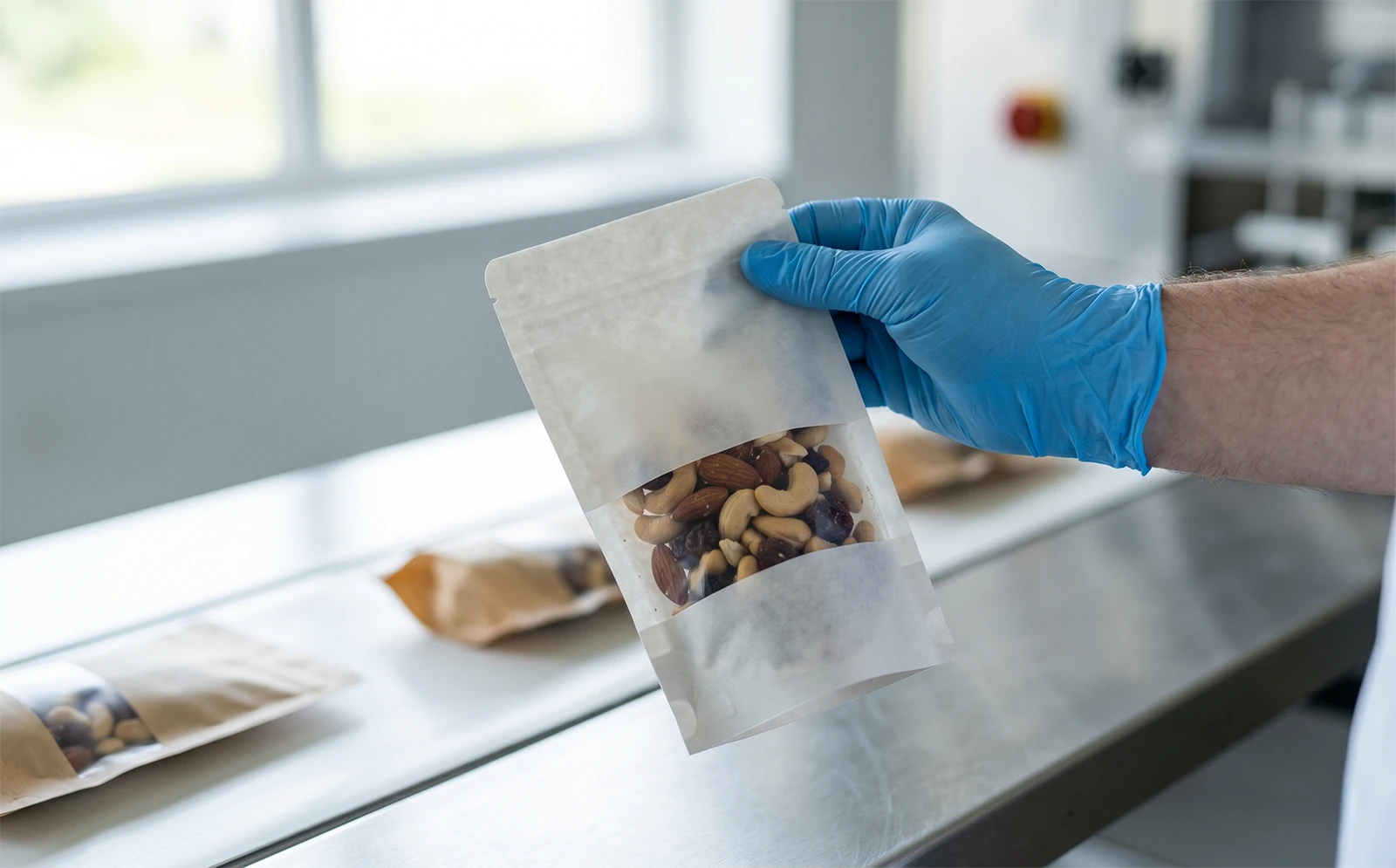
A food packaging machine operates by synchronizing mechanical material feeding, precision dosing, and thermal sealing systems through a centralized PLC unit to create protective enclosures for food products. These industrial systems use sensors and high-speed motors to transform raw packaging materials into finished, retail-ready units with minimal human intervention.
You might find that inconsistent filling weights and weak seals are causing significant product waste in your current manual line. These inefficiencies lead to customer complaints and high operational costs that prevent you from competing with larger industrial producers who use automated systems. Understanding the mechanical logic of an automated line shows you how to stabilize your output and ensure every package meets international retail standards.
What are the primary mechanical stages of a food packaging machine?
The primary mechanical stages involve film unwinding, bag formation, product dosing, and hermetic sealing to ensure the item is protected from external air. A modern food packaging machine executes these steps in a continuous cycle that allows for high-volume output while maintaining tight tolerances on weight and seal strength.
Material Feeding and Bag Formation
The process starts with the film roll being pulled through a series of tension rollers to keep the material flat and aligned. A forming tube or folder then shapes this flat film into a specific container geometry, such as a pillow bag or a stand-up pouch.
Here’s the deal:
- Eye-mark sensors detect printed registration marks on the film to ensure the bag is cut at the correct length.
- Tension control systems prevent the film from stretching or tearing during high-speed movements.
- Forming collars are custom-engineered to match the specific width and shape of your required packaging.
Dosing and Filling Precision
Once the container is formed, the dosing system dispenses the exact amount of food product into the open bag or tray. This stage is where you achieve the consistency needed to avoid product giveaway and maintain your profit margins.
The reality is:
- Auger fillers use a rotating screw to move exact volumes of powders without creating airborne dust.
- Multi-head weighers calculate the best combination of portions to reach a target weight within 0.1 grams.
- Liquid pumps use anti-drip nozzles to keep the sealing area clean and free from contamination.
| Stage | Mechanism | Result |
| Unwinding | Tension rollers | Flat, stable film feed |
| Forming | Forming collar | Consistent bag geometry |
| Filling | Dosing system | Accurate product weight |
| Sealing | Heated bars | Airtight barrier |
The mechanical coordination between the film feed and the filling system ensures that the product enters the bag at the exact moment the bottom seal is completed.
Key Takeaway: Mechanical precision in the forming and filling stages is the foundation of a professional package that protects against leaks and spoilage.
How does the PLC system control the packaging process?
The PLC (Programmable Logic Controller) acts as the brain of the food packaging machine, coordinating sensor feedback and motor movements to ensure perfect timing. It monitors every component in real-time and makes micro-adjustments to the speed and temperature to prevent errors before they result in wasted materials.
Sensor Feedback and Error Correction
Sensors located throughout the machine provide the PLC with data regarding film position, product presence, and sealing pressure. If a sensor detects that a bag is missing or that the film is misaligned, the system can pause the cycle or reject the faulty unit automatically.
Think about it:
- Proximity sensors track the position of the sealing jaws to prevent them from closing on a jammed product.
- Photoelectric sensors confirm that a bag is open and ready before the filling system releases the product.
- Integrated logic allows the machine to adjust its speed based on the flow rate of the product from the processing line.
HMI Interaction and Recipe Management
The Human Machine Interface (HMI) allows you to interact with the PLC logic via a touch screen to select different production parameters. This centralized control makes it easier for your operators to switch between different bag sizes or product types without manual mechanical overhauls.
The result?
- You can store hundreds of “recipes” with specific heat, speed, and timing settings for different items.
- Real-time diagnostics display error codes that help your maintenance team identify the exact location of a mechanical fault.
- Password-protected levels ensure that only authorized personnel can change the core timing logic of the line.
| Controller Feature | Technical Function | User Benefit |
| PLC Logic | Coordinates hardware timing | Prevents mechanical collisions |
| HMI Screen | Graphical user interface | Simplified operator training |
| PID Control | Manages heat bar stability | Consistent seal quality |
Centralized electronic control removes the variability associated with human operators and ensures that the machine runs at its peak efficiency during every shift.
Key Takeaway: The PLC system provides the intelligence needed to maintain high speeds while ensuring that every package meets your quality control standards.
Which sealing technologies provide the strongest barrier?
Thermal heat sealing and ultrasonic bonding are the primary technologies used by a food packaging machine to create a permanent, airtight barrier. Choosing the right sealing method is useful for ensuring that your food product remains fresh during long-distance shipping to markets in North America or Europe.
Heat Sealing and Temperature Control
Heat sealing uses metal bars equipped with heating elements to fuse two layers of plastic or foil film together. Precise temperature management is required because a setting that is too low will cause leaks, while a setting that is too high will burn the film and damage the aesthetics.
Look at the numbers:
- Sealing jaws can exert up to several hundred pounds of pressure to ensure a flat, uniform bond.
- PID controllers maintain the bar temperature within a 1-degree margin to prevent fluctuations.
- Cooling phases after the heat application stabilize the plastic so the bag can be handled immediately by conveyors.
Ultrasonic Sealing for Sensitive Products
Ultrasonic sealing uses high-frequency vibrations to generate friction heat at the molecular level of the film. This technology is often suggested for heat-sensitive products or packages where the seal area might be contaminated with liquid or powder.
The result?
- Cold tools remain safe for operators while the friction creates the bond inside the material layers.
- The vibrations push away product residues like oils or powders from the seal zone to ensure a clean bond.
- Ultrasonic systems use less energy because they only generate heat during the actual sealing millisecond.
| Sealing Type | Power Source | Best Application |
| Constant Heat | Electrical elements | Standard laminated films and foil |
| Impulse Heat | Rapid electrical pulse | Polyethylene (PE) and thin plastics |
| Ultrasonic | Acoustic vibrations | Liquid-filled pouches and sensitive items |
The choice of sealing technology dictates the shelf life of your product and its ability to withstand the pressure changes during air or sea transport. You should also refer to How to Choose a Food Packaging Machine for Modern Lines to determine which sealing method fits your specific bag material.
Key Takeaway: Selecting a sealing technology that matches your film type is the most effective way to eliminate the risk of leaks and oxygen entry.
Strategic Production Growth
The integration of advanced mechanical and electronic technologies allows you to scale your production without sacrificing the safety or presentation of your food products. Reliancepak provides the engineering expertise and reliable hardware needed to transition your facility from manual packing to a high-speed automated operation. Our team is ready to design a system that solves your specific bottlenecks and prepares your brand for the global export market.
We help you meet international quality standards with machinery that is built for durability and precision in every cycle.
FAQ
Can I pack different product types on the same machine?
Yes, if the machine is designed with modular fillers and adjustable software recipes. You can switch between granular products and powders by swapping the dosing unit and selecting the appropriate pre-set on the HMI screen.
How does the machine handle dusty products like flour?
The machine uses a vacuum-sealed auger filler and a dust extraction hood to keep the work environment clean. This prevents fine particles from floating into the air or interfering with the sealing jaws of the system.
Is it hard to maintain the PLC system?
No, because modern PLC units are solid-state and require very little maintenance beyond keeping the cabinet clean and cool. Most troubleshooting is done via the software interface which points you to the specific sensor or motor that needs attention.
What happens if the film runs out during production?
The machine uses an end-of-film sensor that detects when the roll is nearly empty and triggers an alarm for the operator. The PLC will then pause the cycle before the film leaves the rollers to allow for a quick splice or roll change.
Does heat sealing work for all types of bags?
Yes, but the temperature and pressure settings must be adjusted to match the melting point of the specific material. Laminated films require constant heat, while simple plastics like PE often require impulse sealing to prevent melting.