
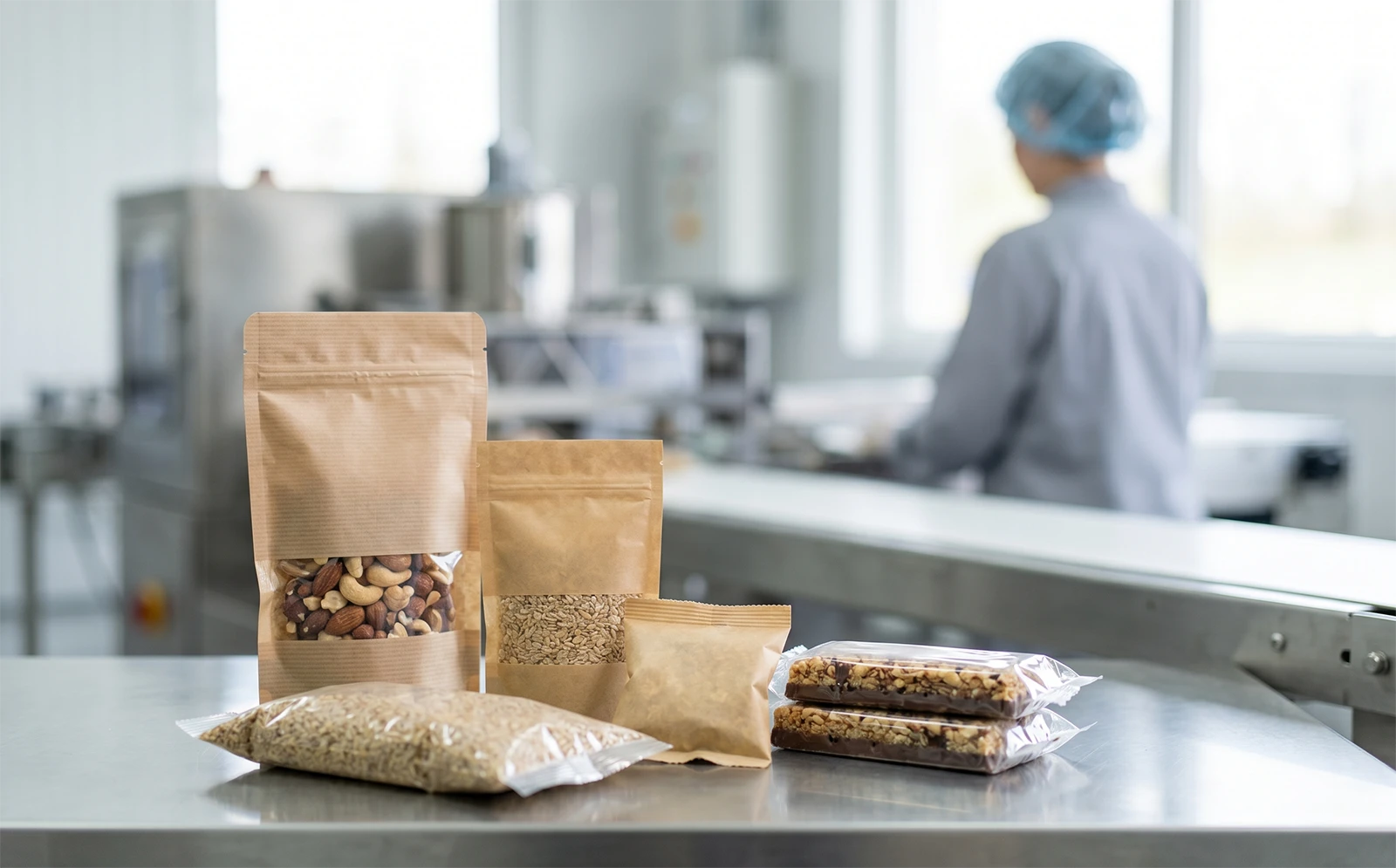
The main types of food packaging machine are categorized by their mechanical orientation, such as vertical or horizontal, and the specific dosing technology they use to handle liquid, powder, or solid products. These systems are engineered to match the physical state of the food item to ensure the highest possible seal integrity and production speed.
You might find that your current equipment struggles with product variety, leading to frequent downtime during changeovers or inconsistent weights that drain your profits. These technical gaps often result in leaked bags and failed safety inspections that prevent your business from expanding into high-end retail markets. This guide details the specific architectures available to help you align your facility with the strategies found in our pillar guide on How to Choose a Food Packaging Machine for Modern Lines.
What are the differences between vertical and horizontal systems?
Vertical systems utilize gravity to drop products into pouches, while horizontal systems wrap solid items in a linear, flat motion. The choice between these two depends on whether your product is loose and flowable or a solid, single unit that requires delicate handling.
Vertical Form Fill Seal (VFFS) Technology
VFFS equipment is the industry standard for snacks, grains, and frozen produce. The machine forms a bag from a roll of film, fills it with the product, and seals it in one continuous vertical movement.
Here’s the deal:
- Small footprint requirements make these ideal for facilities with limited floor space.
- Gravity-assisted filling allows for very high speeds on granular items.
- Compatible with a wide range of dosing heads like multi-head weighers and volumetric cups.
Horizontal Form Fill Seal (HFFS) Applications
HFFS systems, often called flow wrappers, are used for items that cannot be dropped, such as cookies, protein bars, or bread. The product moves along a flat conveyor and is wrapped in a tube of film before being sealed at both ends.
- Provides a very tight, professional wrap for individual solid items.
- Reduced drop height prevents breakage of fragile bakery products.
- Supports high-speed continuous motion for massive production volumes.
| System Type | Best Product State | Sealing Movement | Space Efficiency |
| Vertical (VFFS) | Granules, Liquids, Powders | Vertical / Gravity | High |
| Horizontal (HFFS) | Solids, Single Units | Horizontal / Linear | Medium |
Vertical systems offer the best speed for loose items, while horizontal systems provide the superior aesthetics and protection required for solid, single-serve foods.
Key Takeaway: Selecting the correct orientation is the most basic decision in ensuring your production line operates without mechanical bottlenecks.
Which dosing systems are best for liquid and powder fillers?
Liquid fillers utilize piston or flow-meter technology to manage volume, while powder fillers rely on auger screws to prevent dust and ensure weight accuracy. Using the wrong dosing head for these states leads to leaks or contaminated seal areas that compromise food safety.
Liquid Piston and Pump Filling
Piston fillers are the standard for thick sauces, oils, and pastes. The machine uses a mechanical stroke to pull a precise volume of liquid into a cylinder before dispensing it into the container.
The reality is:
- Anti-drip nozzles prevent product from getting onto the bag seal area.
- Adjustable stroke lengths allow you to change fill volumes via the PLC.
- Sanitary stainless steel construction allows for rapid cleaning between batches.
Powder Auger Filling Systems
Powdered products like flour or spices require a closed system to prevent fine particles from filling the factory air. An auger filler uses a rotating vertical screw to dispense the powder into the bag with extreme precision.
- Servo-driven screws provide accuracy within a fraction of a gram.
- Dust extraction ports remove stray particles before the final seal is made.
- Closed hoppers protect the product from humidity and external contaminants.
| Filler Type | Product State | Measurement Method | Hygiene Level |
| Piston Filler | Liquids and Pastes | Volumetric Stroke | High |
| Auger Filler | Fine Powders | Screw Rotation | High |
Technical matching of the dosing head to the product viscosity or flowability ensures that your weights remain constant across every shift.
Key Takeaway: Specialized filling heads are required to maintain a clean workspace and prevent the material waste associated with inaccurate dosing.
How do rotary pouch machines benefit high-end retail products?
Rotary pouch machines use pre-made bags to provide a premium finish and stronger shelf presence compared to standard roll-fed pouches. These systems are favored by brands that require complex bag shapes, such as stand-up pouches with zippers or spouts.
Rotary Pouch Automation
Unlike form-fill-seal machines, a rotary system picks up a pre-made bag from a stack, opens it, fills it, and seals it. This allows for a much wider variety of bag styles and materials.
Think about it:
- Zipper opening and closing modules are easily integrated for resealable packaging.
- The flat bottom of pre-made pouches ensures they stand perfectly on retail shelves.
- Quick-change grippers allow for different bag widths to be run on the same line.
Multi-Station Versatility
Because the rotary machine has multiple stations, it can perform extra tasks like gas flushing, secondary sealing, or date coding at different points in the cycle.
- Integrated gas flushing allows for modified atmosphere packaging to extend shelf life.
- Double sealing stations ensure a perfect bond for heavy or liquid-filled bags.
- Compact circular design allows operators to manage the entire process from one position.
| Feature | Rotary Pouch Machine | VFFS Pouch Machine |
| Bag Style | Pre-made (Zippers, Spouts) | Roll-fed (Pillow bags) |
| Aesthetics | Premium / Retail Ready | Standard / Bulk |
| Flexibility | High (Multiple bag types) | Medium (Film-dependent) |
Rotary systems are the preferred choice for B2B suppliers who need to provide their clients with a high-end, consumer-ready product.
Key Takeaway: Pre-made pouch systems offer the highest level of retail presentation and functional features like zippers for modern food brands.
Optimizing Your Production Infrastructure
Modern food manufacturing requires a strategic alignment between your product’s physical properties and the mechanical capabilities of your equipment. Reliancepak provides the technical depth and high-performance hardware needed to build a production line that is both efficient and scalable. Our team is ready to design a system that meets your specific industry challenges and prepares your facility for the global market.
We help you achieve consistent quality and safety with machinery built for the demands of the modern food industry.
FAQ
Can I pack both liquids and solids on one machine?
No, because the dosing mechanisms are fundamentally different. A liquid filler uses pumps, while a solid filler uses weighers or cups. Actually, trying to use a liquid filler for solids would cause a mechanical jam and damage the valves.
Do vertical machines take up less space than horizontal ones?
Yes, vertical systems are designed to utilize height rather than floor area. So, if you have a facility with high ceilings but limited floor space, a vertical configuration is the most effective choice.
Is an auger filler required for all powders?
Yes, for fine powders that create dust, an auger is necessary. For free-flowing granules like sugar, you might use a simpler volumetric cup filler, but an auger remains the most accurate choice for fine materials.
Can rotary machines handle different bag sizes?
Yes, but you must adjust the grippers and the HMI settings to match the new bag dimensions. This process usually takes about 20 minutes and is a standard feature on professional-grade equipment.
Are HFFS machines faster than VFFS?
Yes, in many cases, horizontal systems can reach higher speeds because they don’t rely on gravity for the product to settle. In fact, for single items like chocolates, HFFS systems are the fastest packaging solution available.