The future of food packaging automation for 2026 centers on deeper machine intelligence, predictive analytics, and built-in sustainability, transforming production lines from reactive setups into proactive, data-driven systems.
For many food producers, the packaging line remains a bottleneck plagued by unplanned stoppages and the constant pressure to adapt to new eco-friendly materials. Ignoring these shifts means facing rising operational costs and falling behind regulatory requirements. Adopting the coming wave of automation and smart trends directly addresses these pain points, securing both efficiency and market relevance.
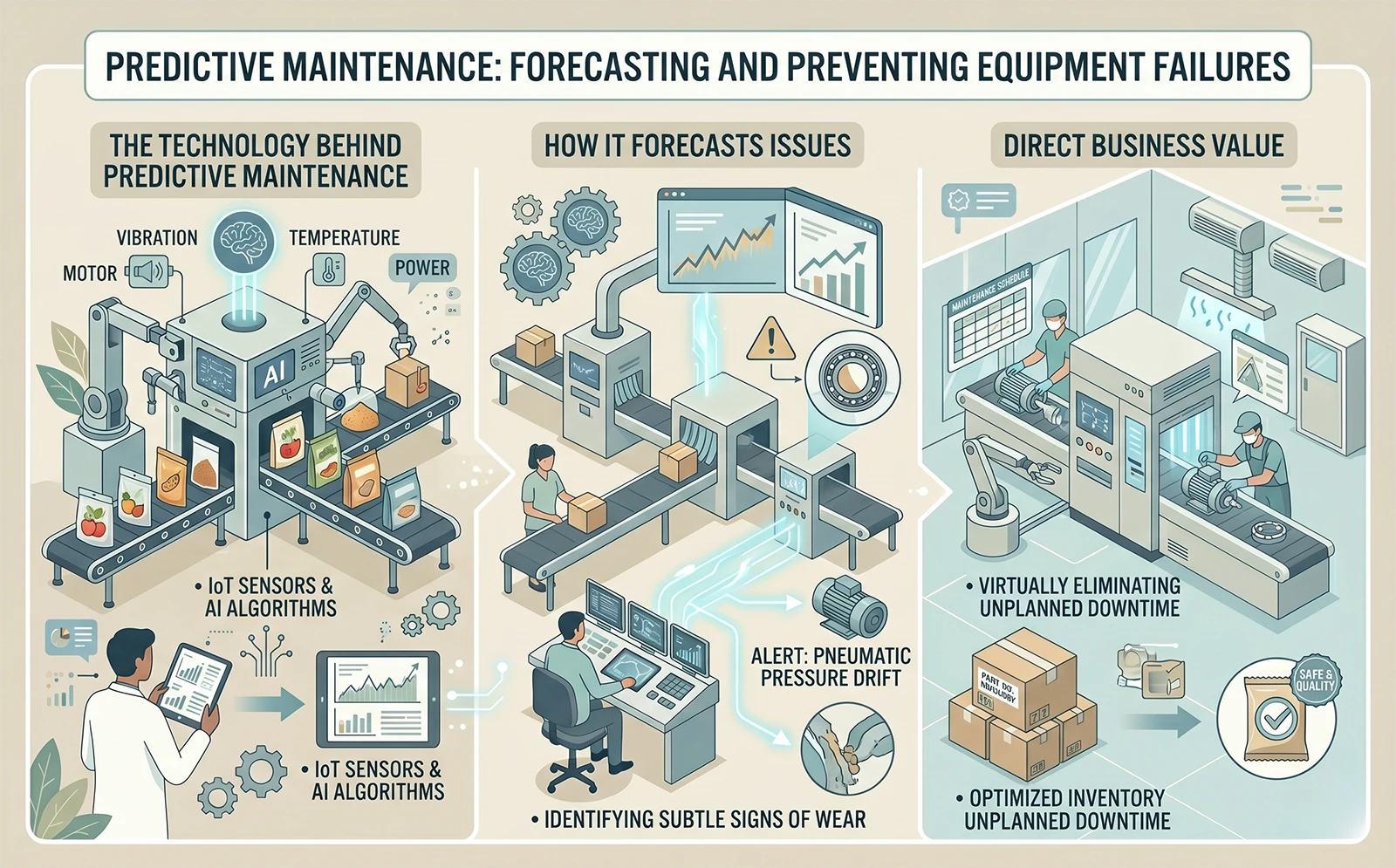
What Is Predictive Maintenance and How Does It Work?
Predictive maintenance uses IoT sensors and AI algorithms to forecast equipment failures before they cause downtime. For a food packaging machine, this means moving from a fixed service schedule to a dynamic, condition-based model. Sensors continuously monitor critical components like motors, bearings, and heating elements, analyzing data for subtle signs of wear that human operators might miss.
This proactive approach is a core pillar of modern factory intelligence. By processing real-time data on vibration, temperature, and power consumption, the system alerts you to specific issues, such as a bearing beginning to degrade or a seal temperature drifting out of tolerance. This allows for planned, targeted repairs during scheduled downtime, virtually eliminating the costly surprises of reactive maintenance.
The Technology Behind the Alerts
The system relies on a network of smart sensors integrated directly into the packaging machinery. These IoT devices collect performance data and transmit it to a central analytics platform, often cloud-based. Machine learning algorithms establish a baseline for normal operation and flag deviations. An alert might be triggered by an increase in motor vibration that precedes a mechanical failure or a gradual change in pneumatic pressure that indicates a developing leak. This transforms maintenance from a reactive chore into a strategic, data-informed activity.
Direct Business Value for Your Operation
The primary benefit is the dramatic reduction in unplanned downtime, which directly protects your production throughput and revenue. Secondary gains include optimized spare parts inventory, as you order components based on actual need rather than guesswork, and extended equipment lifespan through timely, minor interventions. For a food processor, this stability is non-negotiable for meeting tight delivery schedules and maintaining product quality.
Key Takeaway: Implementing predictive maintenance shifts your maintenance budget from unexpected, high-cost emergency repairs to planned, lower-cost interventions, directly improving your bottom line.
How Will Machines Handle Sustainable Packaging Materials?
Next-generation food packaging machines will be engineered with advanced motion control and ultra-precise thermal regulation to process eco-materials like paper-based films, compostables, and bio-polymers. These materials often have a much narrower sealing window than traditional plastics, demanding tighter process control to ensure package integrity without damaging the material.
The design of sealing jaws, temperature control systems, and film tension mechanisms must evolve to provide the consistency required for these sensitive substrates. This capability is no longer a premium option but a baseline requirement for future-proofing your production line against impending plastic bans and shifting consumer preferences.
Technical Adaptations for New Substrates
Modern machines achieve this through servo-driven sealing jaws that apply exact, repeatable pressure and multi-zone heating elements that maintain a precise temperature profile across the seal area. Some systems incorporate vision inspection to verify seal quality in real-time, making immediate adjustments if a seal is compromised. This level of control ensures that switching to a compostable pouch does not result in a spike in rejected packages.
The Commercial Advantage of Early Adoption
By investing in a machine designed for material versatility, you gain immediate compliance with current and future environmental regulations. This protects your brand from the reputational risk associated with non-sustainable packaging and positions you as a leader in your market segment. Furthermore, the energy efficiency of these newer models contributes to a lower overall carbon footprint for your facility, a metric increasingly important to large retailers and consumers alike.
What Are the Implementation Trends and Their Business Value?
The integration of smart technology into food packaging machines follows clear trends that deliver tangible operational and financial benefits. Key trends include enhanced IoT connectivity, AI-driven analytics, and unified remote monitoring platforms.
These trends converge to create a more transparent, efficient, and manageable production environment. A centralized dashboard can now provide a real-time overview of Overall Equipment Effectiveness (OEE), energy consumption, and predictive maintenance alerts for multiple lines, accessible from a smartphone or office computer. This visibility is a powerful tool for continuous improvement.
| Trend | Implementation in Food Packaging | Core Business Value |
|---|---|---|
| Smart Sensors & IoT | Vibration, thermal, and vision sensors integrated into key machine components. | Reduced unplanned downtime and granular data for process optimization. |
| Eco-Material Compatibility | Advanced sealing technology and precision thermal control for paper/bio-polymers. | Regulatory compliance and meeting consumer demand for sustainable packaging. |
| Remote Monitoring | Cloud-based dashboards for real-time OEE and machine status tracking. | Centralized management of multiple production lines and faster decision-making. |
Analysis: This matrix shows that technology investments directly map to solving core business challenges in efficiency, compliance, and management.
Key Takeaway: These implementation trends provide a clear roadmap for upgrading your facility, ensuring that each technological investment yields a measurable return in operational performance and market positioning.
How Can You Prepare Your Production Facility for 2026?
Preparing for 2026 requires evaluating your current packaging equipment against these emerging standards of intelligence and sustainability. The key is to select a food packaging machine that is not only robust for today’s needs but is also designed with an open architecture for future software updates and sensor integrations. This ensures the capital equipment you purchase remains competitive and adaptable for the next five years and beyond.
Focusing on suppliers who prioritize these forward-thinking features, such as built-in data ports for IoT connectivity and mechanical designs that accommodate a wide range of film materials, is a prudent strategy. This approach future-proofs your investment and aligns your operation with the trajectory of the global food packaging industry.
Why choose Reliancepak
Ready to upgrade your packaging line with smart, future-ready technology? Reliancepak specializes in providing advanced, reliable food packaging machines designed for performance and adaptability. Our systems are built to integrate seamlessly into modern, data-driven factories. Contact us today to discuss how our solutions can prepare your facility for the trends of 2026 and ensure your production efficiency remains high.
The factories of tomorrow will be defined by their ability to learn and adapt; choosing the right automation partner today is the first step toward building that resilient future.
Frequently Asked Questions
Can your machines handle compostable or paper-based packaging films?
Yes. Our newer models feature precision temperature control and advanced sealing systems specifically designed for the narrower processing windows of sustainable materials, ensuring reliable seal integrity.
How do I start implementing predictive maintenance on my existing line?
You can begin by identifying critical failure points on your current equipment. We offer retrofit sensor kits and can help integrate monitoring systems that feed into a centralized analytics platform.
Is it possible to monitor multiple packaging lines from one location?
Yes. Our cloud-based monitoring dashboards provide a unified view of performance metrics, OEE, and maintenance alerts for all connected machines, accessible from any internet-enabled device.
What is the typical return on investment for upgrading to a smart packaging machine?
ROI is realized through reduced downtime, lower maintenance costs, and improved material efficiency. Most clients see a significant payback period reduction due to enhanced operational stability and output.
Do you offer training for operating these advanced, automated systems?
Absolutely. Comprehensive training on both the mechanical operation and the data interface is a standard part of our installation and after-sales support package.