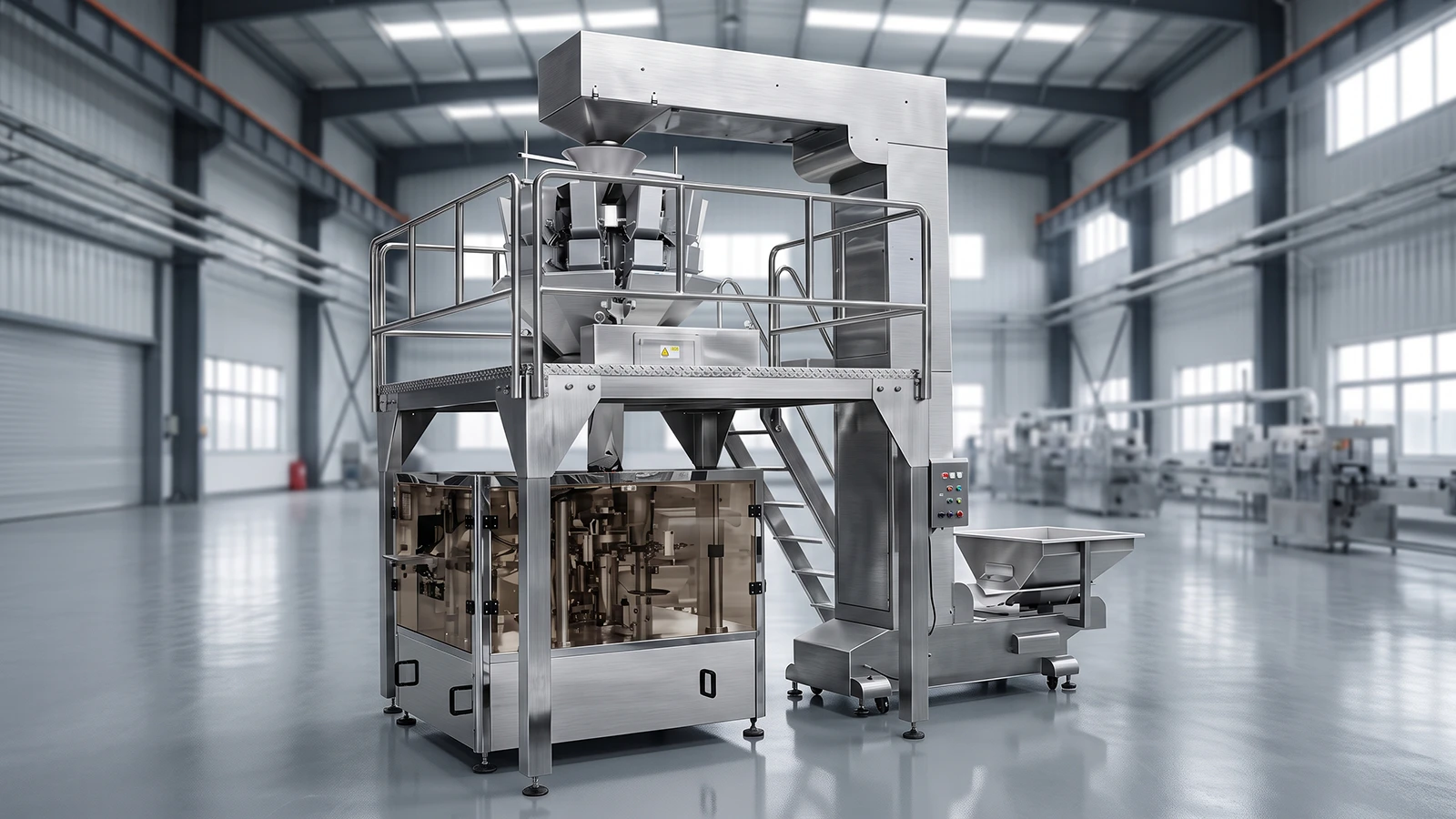
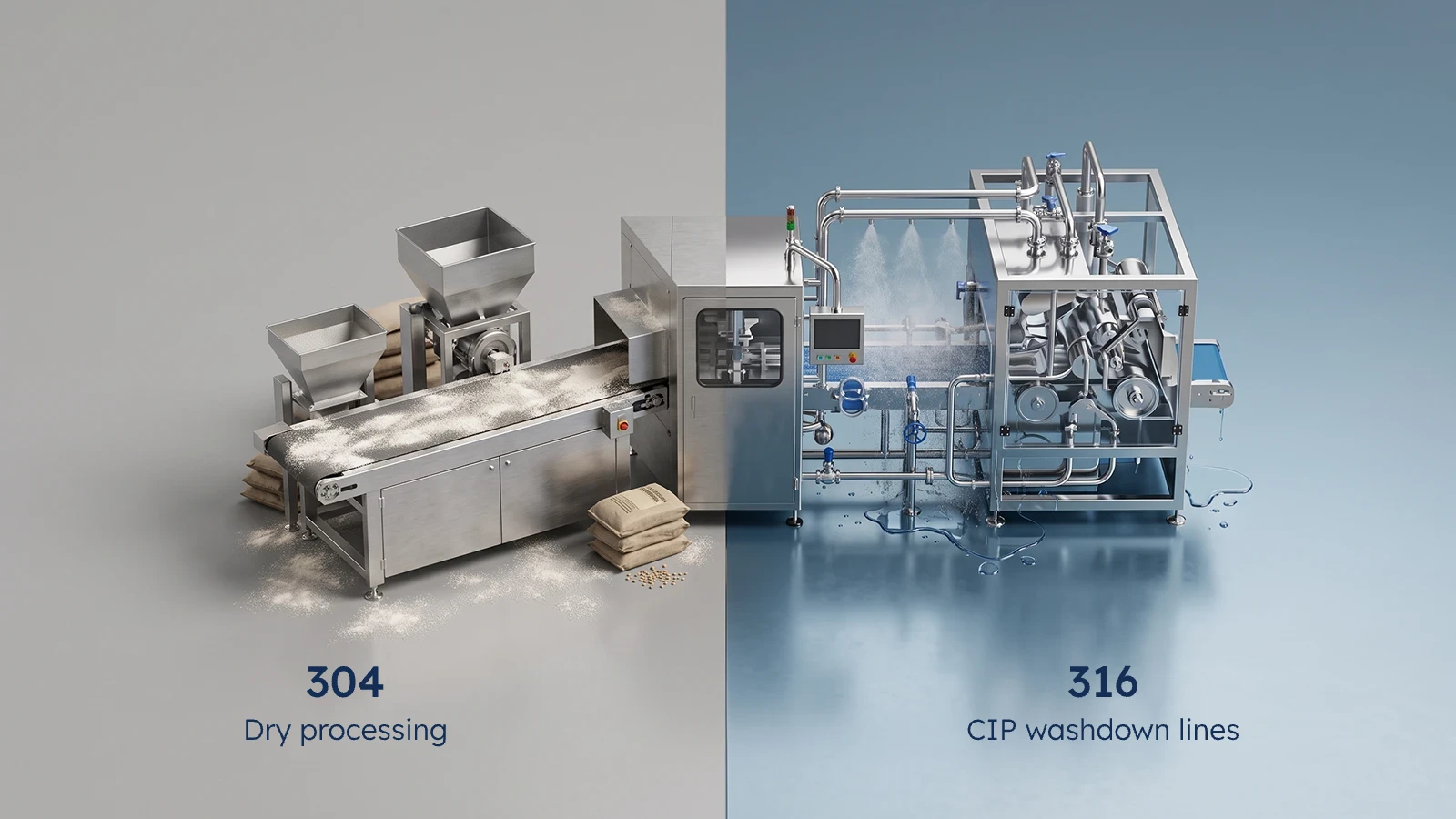
If you are specifying a filling line, a sealing machine, or a conveyor that will touch food, the same question lands in every quotation review: do we need 316, or is 304 enough? The honest answer depends less on the grade itself than on what your product, your cleaning chemicals, and your plant environment will do to the metal surface over the next several years.
This guide breaks the decision into the factors that actually drive corrosion in food plants, shows where each grade holds up, and gives you a framework you can apply to a real equipment specification without paying for alloy you will never use.
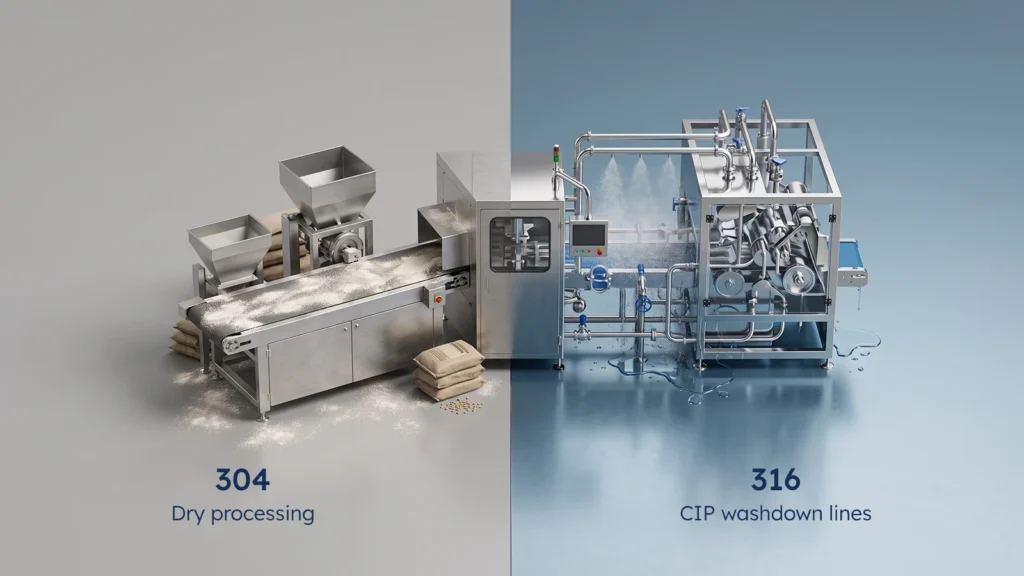
What Really Separates 304 from 316
Both grades are austenitic stainless steels from the 300 series, and both are accepted for food contact surfaces under the major regulatory frameworks. The difference sits in the alloying.
304 carries roughly 18% chromium and 8% nickel, which builds the passive chromium oxide layer that makes stainless steel stainless in the first place. 316 keeps a similar chromium level but adds molybdenum, typically in the 2–3% range, plus a slightly higher nickel content. That molybdenum is what changes corrosion behavior.
Chromium oxide protects well against general oxidation and many organic acids. Molybdenum adds resistance to chloride-induced attack, the failure mode that takes out most food plant equipment: pitting, crevice corrosion, and stress corrosion cracking. If your process never brings chlorides into contact with the metal, 304 performs for decades. If it does, the gap opens quickly.
Keep 316L in mind as well. It is the low-carbon version of 316, with carbon held at or below 0.03%. The “L” matters whenever the equipment is welded, because lower carbon reduces the risk of carbide precipitation along the weld heat-affected zone. Many fabricators now default to 316L instead of standard 316 for exactly this reason.
Where Chlorides Actually Come From in a Food Plant
Buyers often assume chloride exposure means seawater or table salt. In practice it shows up in more ordinary places, and each one is a reason to look harder at 304.
- Brine, salt injection, and pickling solutions used in meat and seafood processing.
- Chlorinated CIP water, which is standard sanitation practice in dairy, brewing, and beverage plants.
- Tomato, citrus, vinegar, and other acidic products that accelerate attack when residual chlorides are present.
- Dairy and cheese operations, where chloride in the product stream meets aggressive cleaning cycles.
- Coastal plant locations, where airborne salt deposits on external surfaces that are rarely rinsed.
None of these automatically rule out 304. A dry bakery line in an inland city and a shrimp processing plant on the coast are not the same specification problem, even when the machine drawing looks identical.
When 316 Earns Its Higher Price
316 costs meaningfully more per tonne than 304, and that premium shows up in the equipment price. It pays for itself in a specific set of situations.
Long CIP cycles with chlorinated water, high-salt products, and equipment that is difficult to inspect or replace are the classic cases. So is anything with deep crevices or welded assemblies where a pitting site can start and stay hidden for months.
When a corrosion failure means a production stop, a recall risk, or a full teardown to replace a welded frame, the alloy premium is cheap insurance.
There is a second scenario that gets less attention: product quality. Iron and chromium ions leaching from a corroding surface can shift flavor and color in sensitive products, particularly beverages and dairy. The issue is not safety so much as batch-to-batch consistency.
304 vs. 316 at a Glance
| Factor | 304 | 316 / 316L |
| Typical composition | ~18% Cr, ~8% Ni | ~16–18% Cr, ~10–14% Ni, 2–3% Mo |
| Chloride and pitting resistance | Moderate | High |
| Common food contact use | Dry products, low-salt, low-acid lines | Brine, dairy, seafood, beverage, CIP-heavy lines |
| Welded assemblies | Workable with correct passivation | Preferred; 316L lowers sensitization risk |
| Relative material cost | Baseline | Higher, typically a significant premium |
| Acceptance for food contact | Widely accepted | Widely accepted |
Cost is expressed qualitatively on purpose. Alloy surcharges move with nickel and molybdenum markets, so any fixed percentage published in a blog post is likely stale by the time you read it.
The Variables That Matter More Than the Grade
Grade selection gets most of the attention in procurement meetings, but surface condition decides whether a given grade survives in service.
Surface Finish and Roughness
A 304 surface finished to a low roughness value and properly passivated will usually outlast a poorly finished 316 surface. Food contact zones are commonly specified with an Ra target, and the exact number depends on your product and the standard you are working to.
Coarse finishes trap residue and moisture, which creates the local chemistry that starts pitting. Finer finishes cost more to produce, and that money is often better spent than an alloy upgrade.
Welds, Crevices, and Passivation
Corrosion rarely starts on a flat, open, well-finished surface. It starts in a weld heat-affected zone, a gap between two parts, a threaded joint, or a dead leg.
Design decisions do more for service life than moving from 304 to 316: continuous welds instead of stitch welds, rounded internal corners, and geometry that drains fully. After fabrication, a proper passivation step restores the chromium oxide layer that grinding and welding disturb.
Cleaning Chemistry
Your sanitation program is part of the material specification. Chlorinated alkaline cleaners, high-concentration hypochlorite, and long contact times push chloride exposure well past what the product itself contains. If your CIP schedule is aggressive and your equipment is 304, the metal will eventually say so. Review the chemistry before you review the alloy.
The Environment Outside the Product Zone
Frames, guards, and control enclosures also live in the plant. In coastal locations or plants with high humidity and airborne salt, external corrosion on structural components causes premature replacement even when the food contact surfaces are still sound.
A Practical Decision Framework
Work through these questions before you accept or reject a 316 specification.
- Does any product, ingredient, or cleaning chemical bring chlorides into contact with the surface?
- Is the equipment cleaned with chlorinated water, and how long does each cycle run?
- Are there welds, crevices, or enclosed volumes that cannot be inspected easily?
- What is the cost of unplanned downtime or a corrosion-driven replacement on this line?
- Is the plant in a coastal or high-humidity environment?
Two or more yes answers generally point toward 316 or 316L. A single yes with a short, controlled exposure can still be fine in 304, provided the finish is good and the passivation routine is disciplined.
Documentation to Request from Your Supplier
A grade name in a quotation is not evidence. Ask for mill certificates that tie the heat number to the material actually delivered, a material test report covering chromium, nickel, and molybdenum content, and weld procedure documentation for contact-zone joints.
For food contact compliance, request the declaration of conformity that applies to your market: FDA requirements in the United States, EU 1935/2004 and its national implementations in Europe, or GB 4806.9 in China. A supplier who cannot produce these documents for the specific machine you are buying is asking you to take the grade on faith.
Builders who treat material selection as a design decision rather than a checkbox will ask about your CIP chemistry, your product pH, and your plant location before they quote. That is the conversation worth having.
Reliancepak’s packaging machinery division at autopackline.com supplies semi-automatic and fully automatic packaging lines for food, pharmaceutical, and consumer goods producers, and reviews stainless specification against real process conditions rather than a default template.
FAQ
Is 304 stainless steel food safe?
Yes. 304 is accepted for food contact surfaces under FDA, EU, and Chinese standards, and it remains the most widely used grade in food processing equipment worldwide. Food safety depends on the finished surface, cleaning routine, and freedom from corrosion, not on whether the alloy contains molybdenum.
Is 316 worth the extra cost for a bakery line?
Usually not. Dry bakery operations rarely introduce chlorides, so a well-finished, properly passivated 304 line will typically serve as long as a 316 one. Direct the premium toward surface finish, drainable design, and cleanable welds instead.
Can I mix 304 and 316 on the same machine?
Yes, and it is common practice. Fabricators often specify 316L for product-wetted parts while using 304 for frames, guards, and non-contact components. Mixing grades is not a corrosion problem by itself, but the joint areas between them need correct design and passivation.
What is the difference between 316 and 316L?
316L is the low-carbon version of 316, with carbon at or below 0.03%. Lower carbon reduces carbide precipitation during welding, which in turn lowers the risk of intergranular corrosion beside the weld. For welded food contact assemblies, 316L is generally the safer choice.
Does a higher grade remove the need for passivation?
No. Passivation removes free iron and restores the passive chromium oxide layer after fabrication, and it applies to 304 and 316 alike. Skipping it leaves a surface that can begin corroding even when the alloy was chosen correctly.