When buyers compare modified atmosphere packaging (MAP) tray sealers, the conversation usually centers on output speed, film width, and gas flush performance. The feeding mechanism rarely comes up — yet it is the component that decides how long your sealing molds last and how much you spend on maintenance over the machine’s life.
This article compares the two most common feed approaches for tray sealing equipment: traditional push-rod (chain-driven or dial-type) systems and clip-box conveying. The difference comes down to one variable — repeatable tray positioning — and it has a direct impact on mold life, downtime, and total cost of ownership.
Why a Few Millimeters of Misalignment Costs Real Money
A sealing mold is engineered to close on a tray that sits exactly where the die expects it. When a tray arrives even slightly off-position, several things happen at once:
- Sealing pressure concentrates on one edge of the die instead of spreading evenly across the flange.
- The cutting edge contacts the tray rim or film at an angle, accelerating wear on the die’s sharpest — and most expensive — surfaces.
- Seals become inconsistent, which shows up later as leakers in your MAP packs and rejected product at quality control.
In a meat packaging line, where trays may carry variable product weights and residual liquids, positioning errors are not an occasional event. They are a daily condition the feed system either handles or passes downstream to your tooling.
How Push-Rod Feed Systems Wear Out Tooling
Push-rod and chain-driven feed systems move trays by contact force: a rod or carrier pushes the tray forward, and the tray stops where momentum and mechanical limits place it. This works acceptably when every tray weighs the same and the line runs a single SKU. In practice, most meat processors run mixed products, and that is where the weaknesses appear:
- Weight variation changes tray behavior. A heavier tray with a loaded protein portion travels and stops differently than a light one, so the final position drifts from cycle to cycle.
- Push speed affects stop accuracy. Faster cycle times increase momentum at the stop point, which makes precise indexing harder exactly when you need throughput the most.
- Chain wear compounds the problem. As chains and rods wear over months of operation, the mechanical reference itself shifts, and positioning accuracy degrades gradually until molds or cutters show visible damage.
The maintenance pattern that follows is familiar to many plant managers: periodic die regrinding or replacement, escalating adjustment work, and unplanned stops when a cutter finally deforms a tray badly enough to jam the station.
How Clip-Box Conveying Works Differently
Clip-box conveying takes a different approach. Instead of pushing the tray and hoping it stops in the right place, the mechanism grips each tray in a dedicated carrier — the “clip box” — and transports it to a fixed, positive location at the sealing station.
Because the tray is held rather than pushed, its final position does not depend on its own weight, the push speed, or the operator’s product loading technique. Every cycle presents the tray to the mold in the same orientation, which means:
- Sealing pressure applies uniformly across the die face.
- The cutting edge engages the film consistently, cycle after cycle.
- Tooling wears at the slow, predictable rate the mold maker designed for — not the accelerated rate caused by off-center impacts.
For a processor, this converts mold life from an unpredictable maintenance cost into a plannable one.
Side-by-Side Comparison
| Factor | Push-Rod / Chain Feed | Clip-Box Conveying |
| Tray positioning principle | Contact push; stop position depends on weight and speed | Positive capture in a dedicated carrier |
| Positioning repeatability with mixed product weights | Drifts with tray weight and cycle speed | Consistent regardless of load variation |
| Typical die failure mode | Edge chipping and uneven wear from off-center contact | Slow, even wear within design tolerance |
| Mold maintenance pattern | Reactive: regrinding, earlier replacement | Planned: scheduled inspection and service |
| Downtime profile | Unplanned stops from jams and die damage | Predictable, mostly scheduled maintenance |
| Suitability for high-mix meat lines | Limited; accuracy degrades with variation | Well suited; stable across SKUs |
What This Means for Total Cost of Ownership
Total cost of ownership for a tray sealer is not the invoice price. It is the purchase price plus mold replacements, maintenance labor, spare parts, and the margin lost every hour the line stands still.
Push-rod systems usually look cheaper up front, and for single-SKU, light-product applications they can be a reasonable choice. But in meat and poultry packaging — where product weight varies within a single shift and liquids make trays behave inconsistently — the positioning weaknesses translate into faster tooling consumption and more unplanned downtime. Over a three-to-five-year horizon, these ongoing costs can outweigh the initial price difference.
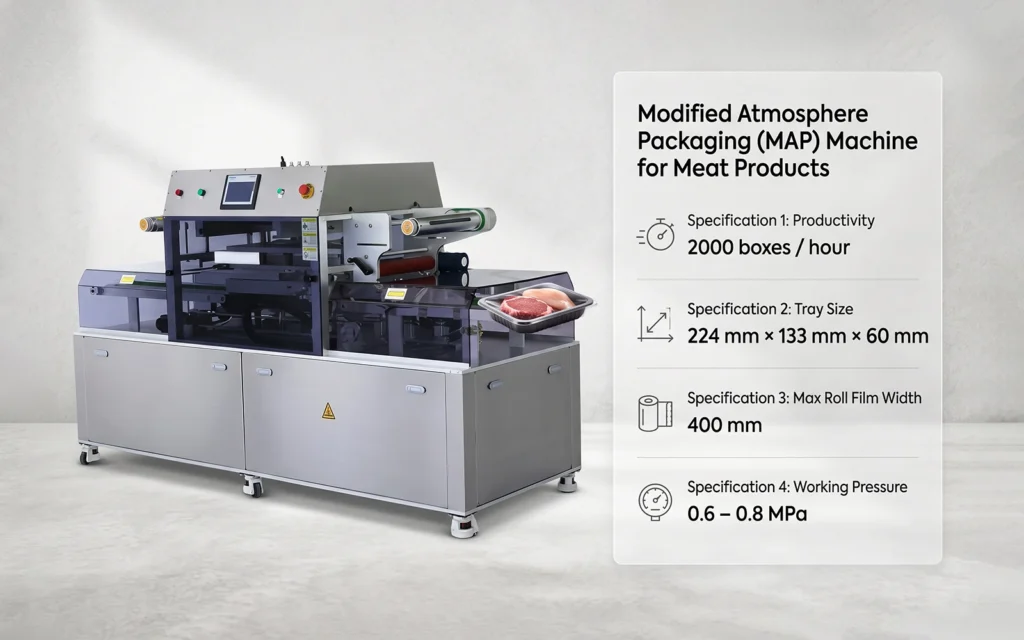
This is why our MAP tray sealing machine for meat products is built around clip-box conveying. The machine holds each tray in a positive location through the sealing cycle, protecting the die set and keeping seal quality stable across mixed products. It runs up to 2,000 trays per hour on 224 × 133 mm trays, with Siemens independent heating zones providing temperature control that matches the sealing consistency the feed system makes possible.
If you are evaluating machines, ask one question before comparing output figures: how does the feed system guarantee tray position when tray weight varies? A clear, mechanical answer to that question tells you more about your future maintenance budget than any throughput number on the datasheet.
Frequently Asked Questions
Does poor tray positioning really affect seal integrity, or only mold life?
Both. An off-position tray receives uneven sealing pressure, which produces weak or incomplete seals and higher leak rates in MAP packs. The same off-center contact also concentrates wear on the die edge. Seal quality problems usually appear first; mold damage accumulates more slowly but costs more to fix.
Can an existing push-rod machine be upgraded to clip-box conveying?
Generally no. The feeding mechanism is a core structural design, not a bolt-on accessory. Retrofitting typically means replacing the conveyor section and the machine’s control logic, which approaches the cost of a new machine. If positioning problems are already damaging your molds, replacing the machine is usually the more economical path.
How much longer do molds last with clip-box conveying?
There is no universal number, because mold life depends on die material, film type, tray material, and cycle count. What clip-box conveying changes is the wear pattern: instead of accelerated, uneven wear from off-center impacts, tooling wears slowly and evenly within its design tolerance. The practical benefit is predictable mold service intervals rather than a specific multiplier.
What should I check when comparing feed systems between suppliers?
Ask to see the tray carrier mechanism in operation, ideally with trays of clearly different weights. Watch whether the tray stops in the same position at the sealing station across consecutive cycles. Also ask how the design compensates for chain or carrier wear over time — a supplier with a confident answer has thought about the machine’s second and third year of operation, not just the demonstration.
Is clip-box conveying worth it for low-volume or single-SKU operations?
Not always. If you run one product at moderate speeds with consistent tray weights, a simpler feed system may deliver adequate positioning accuracy at a lower price. Clip-box conveying delivers its clearest return in high-mix environments — meat, poultry, seafood — where product variation is unavoidable and tooling costs compound quickly.